Showing posts with label book reviews. Show all posts

Friday, December 30, 2016

The Best Young Adult Fantasy Novels of 2016

I know, I know, this isn’t exactly a post about unschooling. And on an unschooling blog no less! How could I? But as the year comes to a close, and I look at my list of books I’ve read in 2016 on Goodreads, I wanted to share some of my young adult fantasy favorites. Why this genre, in particular? Because fantasy (aimed at both teens and adults) makes up at least 90% of what I read, and because I thought some of you might appreciate some good recent books about young people doing extraordinary things. Each of the novels that made it onto my list is the latest in a series, so essentially I’m reviewing each series rather than each book, and I’ve listed the books which came previously--and which were not published in 2016--in brackets. I hope, if you choose to check out any of these books from your local library, that you’ll enjoy them as much as I did!

Poisoned Blade (Court of Fives) by Kate Elliott


Kate Elliott has long been a favorite of mine thanks to her Spiritwalker series, so when she made her first foray into the world of YA fiction with Court of Fives last year, I eagerly snatched it up! And neither that novel, or this year’s follow-up, dissapoint. Our protagonist, Jessamy, wants nothing more than to compete in the dangerous and prestigious Court of Fives, a competitive obstacle course popular with all levels of society. An athlete through and through, she doesn’t want to have to worry about politics. But having been born to--and, shockingly, acknowledged by--a high ranking Patron soldier, member of the ruling class and race, and a Commoner mother, a colonized and oppressed racial group in this Roman-esque empire, for Jess her very existence is political, a fact she just can’t escape. Because change is brewing. Rebellion is simmering amongst a people desperate to hold onto and reclaim their culture; deadly political maneuvering is taking place in the highest tiers of power; and war is approaching with neighboring countries. Jess must carefully make her way in this fraught landscape, striving to protect her family and make the right choices when there are no good choices. More tightly plotted and faster paced than Kate Elliott’s adult novels, I look forward to the next installment.

Reader discretion: Some rather disturbing/gory violence; reference to and threat of sexual abuse/violence; the murder of children.

A Torch Against the Night (An Ember in the Ashes) by Sabaa Tahir


Whereas the above series takes place in a carefully drawn world with distinct cultures, Sabaa Tahir’s world, though similar in some ways to that of the Court of Fives series, feels like the world is simply sketched in. A staged setting where, while a couple of elements might stand out, the majority fades into the background. While that might not be something I’d usually excuse, I can overlook it in this series because the story itself feels meticulously built: Tahir isn’t flying by the seat of her pants, she knows where this story is going. And let me tell you, where it’s going is some pretty dark and brutal places! The viewpoint characters, Laia and Elias (in the second book a third viewpoint is introduced) could not come from more different backgrounds. Laia is born to the Scholars, a conquered people now brutally oppressed by the Empire, and Elias, taken as a child to be trained as a member of the elite soldiers/interrogators/assassins known as Masks, is a bitter and deeply reluctant tool of the Empire itself. When Laia’s family is torn apart, she makes the desperate decision to become a slave and spy, and as her and Elias’ paths cross and their lives become tangled together, they both have to find their own kind of strengths, and figure out just what sacrifices they’re willing to make--and what horrors they’re willing to commit--in order to survive, save those they love, and try their best to do right. This is one of these extremely grim, dark stories with truly horrible things happening pretty much constantly, but which still manages to have hopeful threads throughout. The characters and plot both are extremely compelling, and these books have stuck in my head long after I finished reading them... I really hope the bright spots are built on in the final novel(s?) so that the darkness doesn’t feel completely overwhelming.

Reader discretion: Torture (of both adults and children, including viewpoint characters); murder (again, of both adults and children); slavery; genocide (yes, really); attempted rape.


Crooked Kingdom (Six of Crows) by Leigh Bardugo


Six of Crows sets itself utterly apart by being something I almost never see in fantasy fiction: a heist novel, complete with a mastermind criminal who’s always thinking several steps ahead of everyone else; a sharpshooter with a gambling problem; the best spy (and thief, and occasional assassin) in the city; an incredibly dangerous magic user; an explosives expert with a secret; and an ex-soldier and (mostly ex) zealot who’s roped into all of this very much against his will. Members of an up-and-coming street gang in the bustling mercantile city of Ketterdam, all of them are hand picked by the aforementioned mastermind to travel across the sea in order to steal something of immense value and dangerous political ramifications… Following their theft and all that comes after it, this series is fast-paced, quite dark, often funny, and all around delightful. Watching the bonds develop and deepen between these characters is a real pleasure, and I hope to see more of them in future novels.

Reader discretion: Gore, torture, murder, reference to past sexual abuse/rape, all involving children and teens.

A Gathering of Shadows (A Darker Shade of Magic) by V. E. Schwab


Take multiple Londons (grey London, with no magic; red London, steeped in magic; white London, vicious and starving; and black London, shut off from the others lest it consume them all); a rare traveler able to move between worlds; and a ruthlessly ambitious cross-dressing thief with dreams of becoming a pirate, and you end up with this series. Forming a slightly uneasy truce, world-traveler Kell and thief Lilah must work together to stop a creepy body stealing being, defeat a desperate sorcerer, discover the true nature and limits of their respective magic, and find their own place in the worlds. Though the first book started off a bit slow in my opinion, once I got into it, I was hooked. I positively adore mean and prickly Lilah, and I’m pretty darn fond of brooding Kell and his beloved and rather dramatic brother Rhy (who gains a whole lot of greatly appreciated complexity as the series progresses). In many ways this is classic fantasy: dark sorcerers and evil worlds and the like, but there’s so much about it that feels fresh and original, and I very much appreciate V. E. Schwab’s distinctive voice.

Reader discretion: Attempted rape, murder, torture, creepy body stealing being, mind control.

The Raven King (The Raven Boys; The Dream Thieves; Blue Lily, Lily Blue) by Maggie Stiefvater


If I had to pick just one favorite YA novel of 2016, it would be this one. I don’t think I’ve ever seen a more misleading cover jacket description of a first book, which I believe goes something like “romance blah blah first love doomed to die blah.” In actuality, this is a book about relationships: romantic ones sometimes, yes, but every bit as important are friendships and familial relationships, in all their incredible complexity, fierceness, devotion, tenderness, jealousy… Maggie Stiefvater is a truly marvelous writer, moving from laugh-out-loud funny to lyrically moving between one sentence and the next, dragging the reader deep into a world where the rural Virginian countryside and it’s stark class divides are overlaid by a hidden world of sleeping Welsh kings and mystical forests and dark beings. Following a year in the life of five friends--the decidedly un-psychic daughter of psychics; a ferocious dreamer; a scholarship student desperate to forge his own identity; a quiet, insightful boy prone to disappearing; and a driven, charismatic boy who is going to die. You just can’t look away from their relationships, the beauty of the world they discover, and the creeping horror that is every bit as much a part of these hidden worlds. This series also includes one of the most nuanced and real feeling “coming out” arcs I’ve ever seen, as well as deeply moving and sensitive explorations of the trauma of abuse, of loss, and of growing up. Those themes are every bit as magical as the more fantastic elements. Though there are a couple of things I wish were different about the final installment, it really does do an excellent job of closing one of the best series I’ve read in recent years.

Reader discretion: Child abuse; strong horror elements; murder; suicide (attempted and successful); drug abuse.

What were your favorite novels this past year? Share them in the comments below!

Monday, June 23, 2014

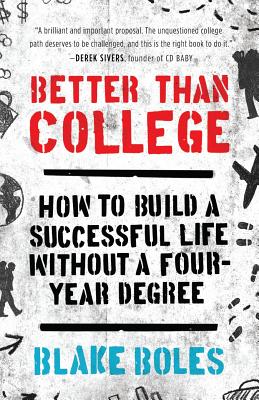
Review of Better Than College: How to Build a Successful Life Without a Four-Year Degree.

I haven't written a book review on this blog for ages. Probably because I've read very few non-fiction books in the last couple of years! But sparked by some newly discovered energy and motivation, I decided to change that, which is why I put aside some time over a couple of days to read Blake Boles' Better Than College: How to Build a Successful Life Without a Four-Year Degree.

The first thing I liked about it was that I could easily read it over a couple of evenings, with plenty of time left over. I'm a fast reader, but even so, this book isn't long. It's concise and straight-forward, which is really nice, as longer, more verbose books on education often just aren't that easy to get through. If you want to appeal to a larger audience, make it something that isn't intimidating to pick up. On a similar note, get rid of any ideas you have about self-published books being sloppy or unprofessional. Thanks, I'm sure, to a lot of work by multiple people, this book looks really appealing. You want to pick it up.

But all that isn't nearly as important as the contents. So, on to that!

There are some things I really liked about this book. I like that it starts with some "propositions" on which the rest of the book is based on, outlining the reasons college might not be as great as it's cracked up to be, and why skipping college might be a good idea. I was happy to see that the idea of it being a "gamble" skipping college was addressed, with Blake pointing out that going to college is just as much of a gamble. Also, of course, some criticism of the cost of college. As Blake writes
This is the real culture of fear that should surround college: not that purposefully skipping college will ruin your life, but that mindlessly attending college (or graduate school) may lock you into a huge pile of debt from which you can never escape.
As I've struggled with figuring out what I'm doing and how to go about doing it, one of the things that never ceases to make me feel better is just going well, at least I'm not in debt.

I also appreciated the big focus in this book on the importance of self-knowledge. To me that's always been an important aspect of unschooling. Knowing yourself, and working to understand more about the way you best function, what's important to you, your strengths and weaknesses, is invaluable. I agree with Blake that that's an important thing to be striving for, whether you're in college or not.

The other main thing I appreciated about Better Than College was that Blake does a very good job of taking the concept and giving you concrete ideas on how to actually implement the whole living-without-college-and-learning-lots-of-stuff-and-becoming-financially-more-secure thing in your own life. Parts were inspiring to me, as Blake makes it seem, if not easy, than at least very doable.

The parts that weren't as strong to me were those talking more about famous successful college drop-outs, quoting The Education of Millionaires frequently, and Blake's list of inspiring people. Made up in large part of financiers, venture capitalists, business writers, and CEO's, they're not exactly the type of people I'd personally look up to. Steve Jobs and Penelope Trunk (author of this charming piece on why women should just put up with sexual harrassment) are not my idea of good role models. With a quote from each "inspiring" person included, one especially stood out to me. William Deresiewicz has this to say:
You can live comfortably in the United States as a schoolteacher, or a community organizer, or a civil rights lawyer, or an artist--that is, by any reasonable definition of comfort. You have to live in an ordinary house instead of an apartment in Manhatten or or a mansion in L.A.... [B]ut what are such losses when set against the opportunity to do work you believe in, work you're suited for, work you love, every day of your life?
My first thought was just really? You can live comfortably as a community organizer or artist? I must just know the wrong organizers and artists... I agree that these are deeply worthwhile vocations, and that you should be able to live comfortably doing such a job. But currently, it can be pretty darn hard to.

This is a good example to me of the obliviousness that seems to run through this book. It seems to have been written mostly for a very privileged audience, and it would have been nice if it was acknowledged that all the suggestions on networking and marketing yourself and similarly hacking your education are likely to work best if you're white, male, affluent (or at the very least middle class), straight, and are generally the stereotype of the entrepreneurial, tech heavy, young professional crowd.

There's a great exercise nearer the beginning of the book, designed to get you to look critically at what's most important to you, and how you can use your skills to help others. I loved it, and the sentiments behind it! But then for much of the rest of the book, everything is couched as a way to gain value or "get" something: get a job, get money, get skills, get ahead. Everything was about networking and badgering people to hire you (and I'm sitting there thinking what about sufferers from anxiety, especially social anxiety?), and seeming to encourage you to look at every single interaction as a networking opportunity. What about simple kindness? Friendships where you're not trying to get anything from the other person other than reciprocal caring?

I ended up liking the first half of this book, with more of a focus on self-knowledge and concrete ways to learn outside of college, better than the second half.

So, I would recommend Better Than College, but with some caveats. I think it addresses some things very well and provides some good tools and ideas, but falls short in other ways.

I hope to continue reading more non-fiction, and have some more interesting books to share soon!

Saturday, October 22, 2011

Review of A Rule is to Break: A Child's Guide to Anarchy

I received this book from the author and illustrator free of charge, but I am not receiving any other type of compensation for writing this review.

It's always exciting getting books in the mail. I always eagerly rip through the packaging, quickly finding a comfy (or less-than-comfy if I'm in a particular rush) place to settle down to rifle through the pages if it's a longer book, and simply read straight through if it's a shorter one.

A Rule is to Break: A Child's Guide to Anarchy by John Seven and Jana Christy Seven, being a picture book, I read reasonably quickly, though I did take a bit of time on each page to fully admire the wonderfully charming artwork.  I've long admired Jana's art, how gorgeous and organic it feels, the colours and textures and style... It's just lovely!  And this book was no different.

Well, not when it comes to the good artwork, anyway.  In other ways, it is VERY different from any other children's book I've read! 

Many (I think it's fair to say most) children's picture books are thinly disguised morality tales, and when not outright morality tales, are still strongly pushing and presenting the norms and expectations of the dominant culture.  Not particularly surprising, really, considering that the writers of most children's books, like most people, are very firmly enmeshed in the dominant culture. And really, doesn't everyone know that children should listen to their parents and teachers, follow all the rules, behave "well," etc.?

John and Jana, unschooling parents themselves, present a very different view in A Rule is to Break, saying on their site "children are natural masters of anarchy, but are too often unaware of the power they wield in their cute little hands, and too seldom encouraged by grown-ups to figure that out!  In A Rule Is To Break: A Child’s Guide To Anarchy that determined little devil girl Wild Child wages her own one-girl rebellion against the stifling world of adults who just want her to behave! And she brings her friends along!"

With advice from "ignore school and read books! Use your brain." and "forget about grocery stores and get dirty in your garden!" to sillier but no less engaging pages urging you to "hug the ugliest monster you can find!" this book is definitely not your run of the mill children's book.  And I love that!  Because what this book really feels like is that it's simply celebrating childhood: the joy, the wonder of discovery, the spontaneity and strong emotions (one page reads "go ahead and get stompy!" with an obviously angry/frustrated Wild Child expressing her emotions in the form of stomping). 

I also appreciate that though identified as a girl by the authors, there's nothing in either the Wild Child's dress or behaviour that conforms to any gender expectations. She's just a kid who likes doing things her own way!

So there you have it.  If you hadn't already gotten that impression, I definitely recommend this book.  I've been bringing it with me on the various trips I've been on in the late summer/early fall, to show to anyone I think might be interested, and have been getting LOTS of positive responses to it!  So if you want to buy it, you can find out how to do so here, OR you can download it for free here!

I hope that you, and any children in your life, appreciate this book as much as I did.

Wednesday, December 16, 2009

Review of For The Sake Of Our Children

“How did we ever decide to deliver our children to strangers with questionable skills during the best hours of the day? In the same way, we agreed to have the birthing process taken away from us by the medical profession. In the same way, we agreed to have our dying taken away by this same profession and the directors of funeral “homes.” In the same way, we agreed to be satisfied consumers of processed food that has been so far removed from its original state that it is unrecognizable, consumers of biased information, misleading and enticing advertising for things like disposable gadgets. In the same way, we have agreed to accept the authority of the State-Mommy-who-watches-over-us.”

For The Sake of Our Children by Léandre Bergeron, translated by Pamela Levac


This is a book about unschooling. But this is not a book *just* about unschooling. It’s a book about attachment parenting, respectful parenting. About sustainable living and farming. It even has a good sized fistful of politics thrown in! In short, this is a book about one man’s life, led trusting and respecting both his daughters and the world around him.

Léandre Bergeron comes from an interesting background: born in Manitoba, educated at a Catholic school in the hopes that he’d one day become a missionary priest, and eventually becoming a teacher, his rebellious nature led him to put all that behind him and move with his wife to rural Quebec. It’s there, on their homestead, that his three daughters were born, and there that the story truly begins.

Léandre shares, in the pages of a journal he kept for a year, his daily life spent with his three teenage daughters, the flowing rhythms of their days that move with the seasons. He shares memories of the past, stories of raising his daughters from the time they were babies, stories of their business (a health food store), the circle of life on their farm... He also shares his very strong opinions on childrearing, education and schooling, and the processed lives so many people live in this modern world. His words are insightful, his writing poetic and flowing, and thus this book was a joy to read. I found it interesting that in most books on unschooling, I find myself nodding in agreement with pretty much everything, whereas in this book, my opinions where more mixed. Much of the stuff he has to say I agree with fully. But there was a fair bit that made me pause, and seriously consider my stance on the matter. Not for anything huge, just at small points throughout the book. This, I believe, instead of taking away from the experience, actually added something to my reading of this book.

I did find myself wanting to hear more about the *entire* family, mom included, because she was mentioned only briefly throughout the book. However, most of what I’ve read on unschooling seems to be like that, only usually it’s entirely from the mother’s perspective. Just one parent’s interactions with their children, not how their family works as a whole, so that isn’t really unique to this book. That said, I found it a very pleasant change to read a book, talking about hands on attachment parenting and unschooling, not just the theory, written by a father. That subject seems to be covered almost exclusively by mothers! I also really liked that this book was about a family in my home province (and current residence!) of Quebec. The translation was great, as you’d never know that it was originally written in another language from reading it, yet at the same time the book felt very *Quebecois*!

Definitely a good read, and a good addition to any book collection on attachment parenting, sustainable living, unschooling, or homeschooling.

Peace,
Idzie

Monday, November 16, 2009

Review of The Teenage Liberation Handbook

I wrote this review for Homeschooling Horizons magazine a year or two ago, and since I've been wanting to share reviews of unschooling books, I decided to post it here!

"In the end, the secret to learning is so simple: Think only about whatever you love. Follow it, do it, dream about it...and it will hit you: learning was there all the time, happening by itself."
Grace Llewellyn

The Teenage Liberation Handbook: How to Quit School and get a Real Life and Education by Grace Llewellyn

This has to be the most inspiring book I’ve ever read. I’m actually at a bit of a loss for just how to get across how amazing I found this book… I suppose I should start with how it affected me personally. I’ve always been an unschooler, and I read some of this book years ago, but the last year I was seriously questioning the path that my education had taken. Was I doing the right thing? Should I really be in school instead? Or at least studying textbooks? Then I picked up the Teenage Liberation Handbook once again, and my worries melted away. Here in my hands I held a virtual goldmine of ideas, resources, encouragement, and practical advice. Written with passion and conviction, liberally peppered with stories of real life teenage unschoolers and the marvelous things they’ve done (least fascinatingly to me getting into prestigious universities, but that means a lot to some people), and continuously inspiring. Although aimed directly at teenagers still in the school system, with advice on convincing your parents that unschooling can work, to legal issues, to worries about socialization, I found it equally useful as an unschooler, with such wide ranging chapters giving ideas for things you can do for every traditional school subject, and some less traditional ones, as well as getting into colleges and universities, finding meaningful volunteer and paid work, doing apprenticeships, starting your own business, traveling the world… If ever you thought unschooling couldn’t work, or you simply need to be inspired, then this is the book for you. I feel like I’ve started my own education all over again. I’m actually exited about learning for the first time in a while. Good job Grace! Grace does have some very strong opinions. Since I agree with most of them, it wasn’t a problem for me, but it may be for some people. That’s the only even possibly negative thing I can say about the whole book! Read it. Love it. And most importantly, love learning.

Peace,
Idzie

Friday, November 6, 2009

Review of 101 Reasons Why I'm an Unschooler

Today, I received a veritable jewel of a book in the mail, entitled 101 Reasons Why I'm an Unschooler by PS Pirro. It's a small, slim, volume, one that could quite easily be overlooked when grouped among the vast array of unschooling books out there, but hopefully won't be, because it's a wonderful read! Described as an "unschooling manifesto", this book is exactly what it sounds like: 101 reasons why the author is an unschooler! Delivered in short, bite sized pieces, each reason delivers a clear point, something to think on, and this format makes it very readable, whether you read it straight through like I did, or just flip open a page for a short, inspiring thing to remind you why you've chosen unschooling!

Divided into two sections, the first 50 reasons are basically anti-school: why the author is not a compulsory schooler. And let me tell you, those reasons are very convincing (not that I needed any convincing, obviously... :-P)! Covering such things as "School Steals Your Freedom", "School Rewards Conformity", and "Drugging The Kids", I wish I could convince some pro-school people I know to read it, since hopefully it would shake their perceptions on schooling a bit!

The second section is 51 reasons why the author is an unschooler, and what wonderful reasons they are. :-) From "Staying Up Late", to "Real Learning Happens In The Real World", the author details some of the wonderful reasons we unschool, highlights the perks, as it were, of living this free life.

I read the entire book aloud to my mom, with frequent pauses in reading to discuss one point or another, and we both agree that it was a lovely read. Inspiring, thought-provoking, and just generally a good way to pass a gloomy Fall afternoon! Highly recommended.

If you want to read more from PS Pirro, you can check out her blogs, Over The Wall and Crooked Mile.
----

Also of note, this is the first in a series of sorts, as I've got several other books on unschooling and self-directed learning that I'm planning on reading and reviewing, so keep a look out for future posts about great unschooling books!

Peace,
Idzie