Showing posts with label About me. Show all posts

Friday, June 26, 2015

I'm Here and I'm Queer

I’ve been wanting to write this post all of June, since it’s Pride month, and today on a day when my social media dashes are blowing up with rainbows over the legalization of same-gender marriage in the United States seems like a pretty good time!

First thing you should know? I’m queer.

What does that mean to me? Basically that I have the capacity to be attracted to, get crushes on, and fall in love with people of any gender.

I’m pretty much as “out” as I can be in most areas of my life. I even make a point of saying I’m queer on my unschooling Facebook page every now and then, and I lose “likes” every single time.


I’ve had people say it’s inappropriate to talk about “what I do in the bedroom” which is such a ridiculous statement, since I’ve never said anything more than I did just now in this post.

I’m queer. I’m into people of all different genders.
It’s not about sex: it’s about who I like and love, and how welcome--and how safe--I feel in any given group. It’s about the internal struggles I’ve had to go through to accept this part of myself that I didn’t see reflected anywhere around me, that caused a lot of anxiety and fear and a little bit of shame, too. It’s about how I present myself, how I want to be seen and understood, how I experience the world. It’s a part of my identity.

My queerness doesn’t wholly define me. Of course it doesn’t. But it is part of what defines me as a person, a piece of the Idzie puzzle.

And as with many positive things in my life, unschooling had something to do with where I’m at now. More specifically, the unschooling community, and all the queer friends I made in it at a crucial time in my life. I was really questioning my identity in my late teens, and there were so many patient, supportive new friends who listened to my fears, validated my feelings, and assured me that I didn’t have to attain some pinnacle of queer perfection to identify as such.

Basically? I met a bunch of people who understood what I was feeling, and who welcomed my confusedly queer self with open arms.

So on this day, a landmark occasion in the US, I figured I’d take the time to be even more out, and to remind people that you’re surrounded by LGBTQIA+ people, whether you know it or not. Don’t make assumptions about who people are and who they like based on their perceived gender. Don’t assume your children are straight and cisgender. Leave space in your words and actions for people of all stripes, so that when someone you love is ready to start sharing more of their true selves, they’ll know you’re there to listen and support them.

Happy Pride month everyone!

Monday, June 2, 2014

A Short Interview With An Idzie: Making the Choice and What Separates Unschooling

I recently did an email interview for the Romanian website Think Outside The Box, which you can read in that language here. I'm happy to also be sharing that interview here, in it's original form! 

Why unschooling and not homeschooling? Why was that the choice versus homeschooling and, of course, versus public schooling?

Why not public schooling was, well, a mix of things. My mother never wanted to send me to school, but because my father wanted to, I went to kindergarten. However, there were quickly problems (weird/obscene prank calls from a kid a couple grades ahead of me, as in, grade 2) which convinced my father that maybe homeschooling was a better option.

As for the why unschooling question, unschooling is something we just organically moved into. The home education in my family was relaxed from the start: I didn't have to do a set amount of things each day, and though my mother started out with some curriculum, when it came to everything but math I was free to stop using anything I wanted to. Over the years, our house just filled with interesting books and games, we went to a couple of different homeschool coops and classes, and participated in a range of different activities, from nature clubes to French classes. Me and my sister, who's two years my junior, learned about whatever excited or interested us, always with an enthusiastic parent ready to bring us to the library, search for relevant local events, and otherwise assist us in our pursuits.

After finally saying no more math textbooks, I hate this to much at around 10 or so, I'd say we truly became unschoolers, though we didn't start using that term until a couple of years after that.

Our learning experience though, no matter what term we were using at any given time, was always something very flexible and driven largely by passion. My mother has always been and continues to be truly passionate about learning things, all kinds of things, and that really influenced her approach to parenting and home learning right from the start.

What do you consider to be your most important accomplishments due to unschooling (what's the best things you think you came to experience because you were unschooled instead of being in a system)?

One of the best things is definitely the writing and advocacy stuff I've done! I have a successful blog, I've done public speaking as far away as Texas and as close as my home city of Montreal, my writing has appeared in multiple magazines and a book, and I've gotten messages from people all over the world telling me how much they appreciate my writing. That means a lot to me, and I'd say all that is an accomplishment (or series of accomplishments) I'm really proud of. Essentially I've built a name for myself as a writer and speaker!

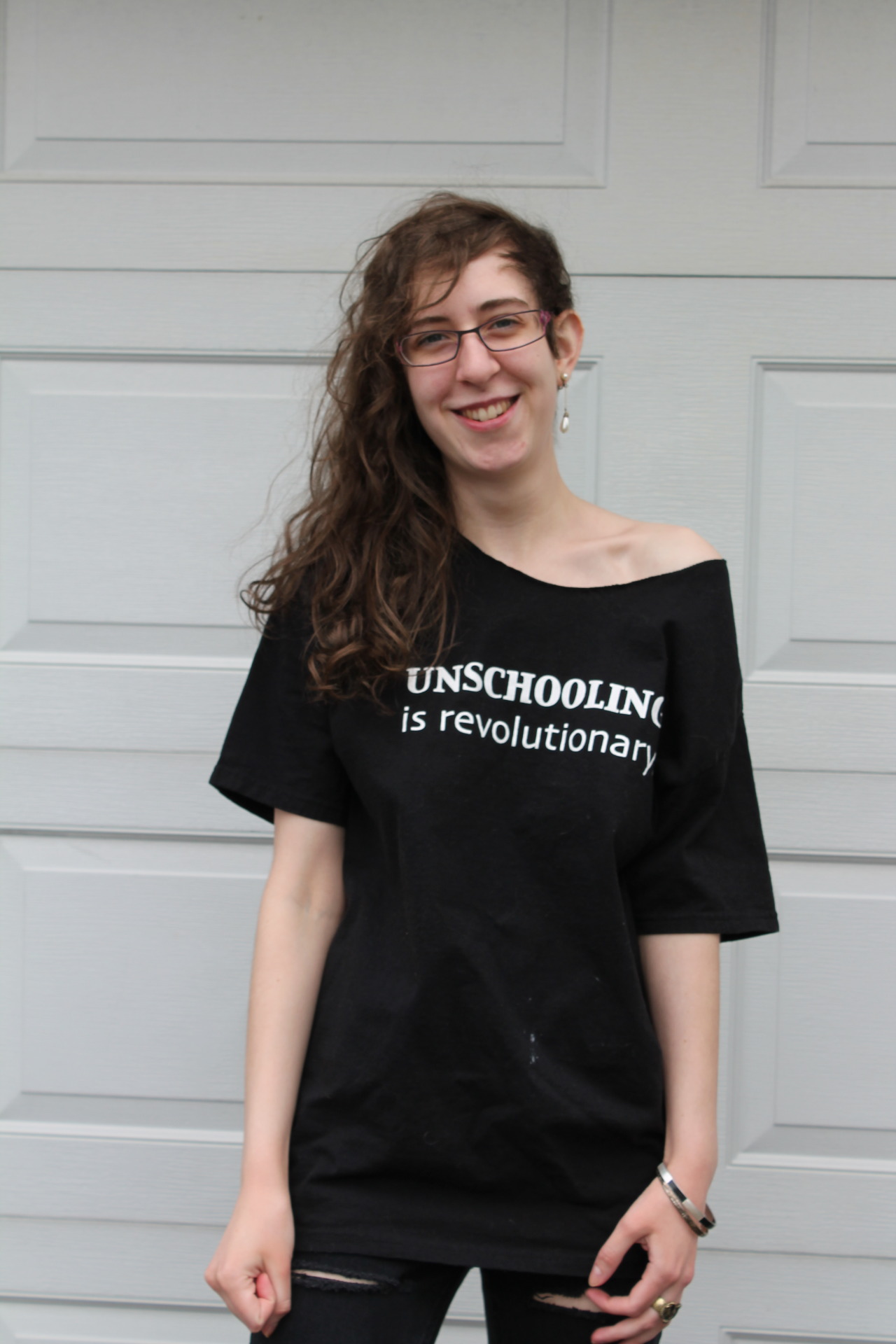
Check out the T-shirt! Pretty cool, huh?
Will unschooling be the choice for your children, in the future or will you let them choose for themselves if they want to be in school or not?

I definitely plan to unschool my kids, though when they're older, they'd be free to make their own choices about whether they go to school or not. When they're younger? I don't know, and I don't think that's a question I'll be able to answer until I do have kids. I think it would depend on my child and the general situation, as well as the school options available.

What did your parents, family and friends think about you being unschooled, in the beginning and what do they think now?

Honestly? For the most part I don't know. Perhaps surprisingly, unschooling isn't something I discuss regularly with people who aren't interested specifically in homeschooling or alternative education. One close friend whom I've known for years still likes to mention that my sister and I are unschoolers when introducing us to new people, since he seems to find the fact either an interesting anomally or an important part of our identity. I'm not really sure which. My mother was the most enthusiastic advocate for home education and later unschooling, and that hasn't changed to this day. My father's feelings have gone up and down over the years, I believe, sometimes worrying, other times feeling better about things. All in all, I'd say it's a pretty mixed bag.

Which are, in your opinion, the most important features of unschooling, the ones that make a real difference for life, for unschooled children, compared to the public schooled kids?

Firstly the flexibility and personalization of unschooling. The fact that each and every unschooler is learning about different things in a different way, guided by their interests, their needs, their family, and their communities. To me that's something truly special, the ability to have so much choice and options in what and how you learn from a young age. I also believe that this can contribute to a healthy community, with a variety of individuals who have different skills and strengths, who are confident in what they know and are good at.

And secondly, being able to learn in an environment that feels safe with support that feels nurturing. Without the competition, stress, and shame often induced by trying (and sometimes failing) to learn things in a school setting, there's just so much less pressure and so much more joy that can come from learning. If you don't have that terror of failing in front of a whole bunch of others, if you don't have a teacher watching you with eagle eyes and standardized tests measuring whether you're doing good enough, it can be a lot easier to to take risks, try new things, and explore new skills without fear. I believe getting to choose which environments (classes, coops, groups, home, libraries, community centers) feel good to be in is a really powerful thing when it comes to emotional health and growth. It's important for kids to branch out, and take on new situations as they feel ready and able to, instead of being thrown into an environment that might be causing a whole lot of stress and anxiety with no option to leave it.

To sum it up, I think the biggest difference with unschooling, as opposed to schooling, is that each unschooling journey is entirely unique and built around the needs and desires of the learner, and that children are allowed to grow and learn in a respectful and caring way that promotes well-being.

Monday, October 7, 2013

Anxiety: A Memoir, or How Living With a Mental Illness Sucks

For a long time now I've been wanting to write this post. It's been rattling around for months now, as an idea, and as something I feel almost compelled to share before I can even think of writing other posts. But I haven't until now because, honestly, writing has felt so hard, and this subject is so scary. It's a real baring of my most intimate life and insecurities, and there's always the terror of  not knowing how people will react.

But now it's mental health awareness week in the US. It isn't here in Canada: our mental health awareness week is in May, apparently. But seeing posts about mental illness starting this week from various networks of mine, it felt like a sign, or perhaps more just the final push I needed.

I have a (or more than one) anxiety disorder. As for what precisely in that category of various anxiety based disorders I live with, who knows. I think generalized anxiety disorder sounds most accurate, my GP thinks panic disorder and maybe obsessive compulsive disorder. I haven't sought the official diagnosis of a psychiatric professional for some very good reasons that I don't want to get into here. And really, I don't particularly care. I only care that I can say "I have an anxiety disorder" because it can help me find people who understand, and because I really hope that people will take me seriously (though with how shitty people dealing with mental illness are often treated, I'm probably hoping in vain). I'm not just kind of stressed, or worried, or what have you. I'm anxious. All the time.

I've been making a conscious effort in the past year to be more open about my anxiety, but I find myself easily slipping into talking about it in a colder, more detached way, or simply in a super brief and non-explanatory way. I have an anxiety disorder. I deal with a lot of anxiety. It's not actually that hard to say that. What's hard is talking about what that actually means in my life.

I've struggled with anxiety for most of my life. As a small child, I can remember holding my pee for hours when I was out, because I desperately didn't want to use the public toilet. When I eventually did, if any part of myself, my clothing, or my bag so much as brushed any part of the toilet (or perhaps even worse, the sanitary napkin disposal box), I would just shut down. Any further enjoyment I might have gotten out of the day was ruined, and I'd barely interact with anyone after that if I could help it. Because internally it was all about that moment of contact in the bathroom, paying attention to everything that that contaminated part of my skirt then touched: side of hand, purse, knee. So that I could make sure that I washed everything that was contaminated once I got home. When other children would come over to visit, I'd hang around near the bathroom door when they used it, to make sure I heard them wash their hands (and would go to my mother panicking if I didn't hear those taps go on).

As you're probably starting to realize, anxiety around cleanliness has always been a big thing with me. Health, too, relatedly (those "signs of a heart attack everyone should know!" things that go around the internet are really hard for me, as hearing about horrible diseases/illnesses I might have often leads to my having to spend several hours or more talking myself through my anxiety, and convincing myself I'm almost certainly not dying of something awful). And really, when it comes to cleanliness related anxiety, I've gotten a whole lot better. I learned, over the years, how to cope a lot better, and there are plenty of things that no longer bother me at all. There are still lots of things I do on a daily basis, lots of habits, that keep my anxiety about cleanliness specifically at bay, but the only time I have major meltdowns or shutdowns about it are when I'm already struggling: almost always when I'm away from home (the place I get to have control over, minimizing triggering things), tired, in a new or especially stressful environment. When those breakdowns do happen, it can be discouraging realizing I maybe haven't come as far as I'd thought I had, but I try to focus instead on how very much progress I have made.

Which is really part of the reason this past year has been so difficult. I stopped writing so much on this blog because, as I said about a year ago, unschooling and alternative/radical education is no longer something I feel as passionately about. Or, more accurately, I'm just not interested enough in it any longer to focus as much time on the subject as I had been. But I didn't mean to drop this blog as completely as I did. That happening has more to do with how much my mental health went down the toilet last winter, and has stayed at pretty much toilet levels since then.

It confused me, at first, because my primary relationship to anxiety has always been through the specific areas of cleanliness and health, yet my anxiety around those things has been at fairly steady levels for years. That didn't really get worse. But the constant fairly low-ish levels of anxiety I was used to living with started going up. And when the anxiety you constantly. Feel. All. The. Time. Gets to a certain point, you start to no longer be able to deal with even the smallest stressors, and even getting out of bed, getting dressed, and leaving the house start to be really, really hard. Anxiety has always made those things more difficult for me than for plenty of other people, it's seemed, but this seemed to be new levels of difficult, or at least more difficult than I'd experienced in years.

Physical health problems I'd dealt with in small ways for years started getting worse and worse, until I finally realized that it wasn't normal to constantly feel weak, to wake up never feeling rested, for my shoulders to be constantly knotted in lines of tension, for my heart to regularly race, to feel dizzy, shaky, and short of breath every single day. The multiple headaches (some mixture of tension and migraine headaches) a week I've been experiencing for years started to feel harder and harder to deal with. I didn't know what was wrong with me, physically, because I never imagined mental illness could have such a huge physical effect.

When I was a teenager, I'd sometimes get panic attacks. For those who've never gotten one before, it's a feeling of absolute terror, like you're dying. My heart would race, I couldn't breath, I'd have hot and cold sweats, shake violently, and yet with all of that also feel the strangest sense of detachment (which I quickly learned was known as "disassociation"), as if I was removed from my body. My previous experience with panic attacks made it confusing for me now, as I wasn't having full-blown attacks so felt my anxiety couldn't be *that* bad, even if the fear of having one still came regularly with a racing heartbeat, lying in bed in those hours between 2 and 4 am, when everything is too still and all your fears can find you. But because I could talk myself down enough for the panic to not get that bad, I felt my anxiety couldn't be all that bad, right?

Until a scary and embarrassing 911 call, made when my hands cramped up so badly from hyperventilating that I couldn't move them at all. That, and seeing a doctor, something terrifying and difficult and a decision made when the terror of not knowing what was going on with my body outweighed the terror of seeing a new doctor, made me realize that I'd literally been hyperventilating daily, for weeks, and just been unaware of it. Tingling hands, shortness of breath, dizziness? Just a regular fixture of everyday life, and also likely what's known as limited symptom attacks.

It was hard to realize that most of the health problems I've been dealing with are almost certainly anxiety related. And it has been difficult, yet also felt very important and healing, to finally, finally stop minimizing and dismissing my struggles. After years of going it's not so bad. Other people have it worse. I mean, I'm not *really* ill. Years of missed opportunities and meltdowns and regrets all because of anxiety. To finally be honest with myself, and say: this is a problem, I'm sick, and neither ignoring it nor putting myself down for it is helpful or healthy.

And about a month after making that conscious decision, I am doing a little bit better. I'm hyperventilating a lot less, and getting better at stopping the panic faster. I've tried out some meds to help reduce the amount of headaches I get. I feel like recognizing I have an illness and realizing I need to make conscious, deliberate steps to improve my health has been a bit of a turning point, and I'm doing better. Not good, but better.

And now I find myself turning outwards, not being solely focused on internal struggles, but also wanting to communicate my struggles, explain to people what's going on. Which is scary, not the least of which because people often react in really unhelpful ways. Without knowing about my illness, people have been saying hurtful things for years. As I wrote in a Facebook note about a year ago, my first time publicly talking about my anxiety:
people say the most hurtful shit to me, without having the faintest clue how hurtful it is. People crack jokes about me being a clean freak, tell me I should have a clipboard/respond with a “yes boss”/otherwise imply I’m being unreasonable and bossy, and similarly make an issue of my saying “that’s not clean” or “please wash your hands” or “please don’t put that on the table.” Which makes me feel really bad, to the point that sometimes I feel like bursting into tears (though luckily I generally manage not to). I feel really self-conscious about how others see me and my anxiety, and the best possible reaction is for people to at the very least act like they don’t find anything I’m doing, or politely requesting that they do, odd. I don’t want people to notice my anxiety, and I REALLY don’t want to be mocked for it. My family can make jokes about it without it being hurtful, but unless you know me well enough to feel you have a really good idea of whether I’ll be hurt by your joke or not, you shouldn't make it.
It's easy for people to make such comments in ignorance, because if I don't tell people about my anxiety, they don't know. I'm good at hiding it. Seeing as I've struggled with it since I was 6 or 7, you could say I have a lot of practice. I've carried on conversations with people while hyperventilating, my hands shaking heart racing, and they can't tell anything is wrong at all.

But even when I tell people, even when they do know, people say the most insensitive things. Become Buddhist! Try meditating! Just take deep breaths! Don't worry! All of which, to someone who's been constantly anxious for almost as long as they can remember, can feel like a slap in the face. Thank you, it never occurred to me to just take deep breaths. And offering meditation alone as a "cure" feels to me like handing a bandaid to someone with blood gushing from their slashed femoral artery and saying that will make it all better! 

I'm not saying that religion or meditation or mantras or many other things can't help people deal with their anxiety, because it can, but for someone without anxiety to think they can solve someone else's extremely difficult struggle with a perky suggestion of a lifestyle change, as if it was that easy, feels more insulting and hurtful than anything else.

Now as I come to the end of this post, I'm trying to feel out what the purpose of writing this is. And it's that I'm trying to be more open about this struggle, because hiding it makes me feel worse, not better. Because I hope that by sharing this struggle, as someone whom apparently other people admire, I hope people carrying stigmas about those with mental illness can examine any prejudices they might hold. And because I know how very, very helpful it has been for me to know I'm not alone in these experiences, and I hope that other people can know that too.

I'll be okay. I have supportive people in my life, and I don't want any of you kind people to worry. I just wanted, as always, to share.

Tuesday, September 13, 2011

Against the Current: Talk from the Toronto Unschooling Conference

I just arrived home yesterday from the Toronto Unschooling Conference, which was a truly lovely weekend.  Talking to lots of cool people, hanging out and just relaxing...  And, of course, presenting a talk.  Being the perfectionist that I am, I still have some feelings of oh, I should have written the talk sooner.  I should have practiced it more.  I should have spoken slower.  But honestly?  Overall I'm pretty happy with how it went!

It really is too long for a blog post, yet unlike last year's talk, I really don't feel like this one can be broken up into multiple posts.  So, I shall simply post it all despite it's length, with a "read more" option so people who aren't interested don't have to scroll forever to get to older posts...  So, here it is!

Against the Current

Introduction
When I was six, I went to a street fair with my mother.  My little sister was probably there, too.  There were booths, from different companies and organizations, as there are at every street fair I’ve ever been to.  One of them was about the meat industry—it was probably PETA—and I think that’s the first time my young self made the connection between those furry and feathery creatures I so enjoyed spending time with, and the food on my plate.  Right then and there, I decided I was no longer going to eat meat.
I don’t even truly remember this incident.  When I try and pull it up in my mind, all I get is the shadowy almost-memory of a story told so many times, you can almost see yourself there.  My mother is the one who always told me this story, until I got older and started repeating it myself to those who queried me in-depth about my dietary choices.
I didn’t stop eating meat right away.  As determined as I was at six, Chicken McNuggets and hot dogs proved too much of a temptation right up until I was eight and gave those up for good, too.
But the decision was made at six, the summer after my parents pulled me out of kindergarten, and looking back now, I feel like that was probably the first major decision I made in my life that went against the current.  It seemed like everyone else ate meat, but this was not something I wanted to participate in.  This is yet another time when I’m so grateful to have parents that supported such a decision, despite my young age.
Now, this isn’t meant as a morality tale.  Though I still don’t eat meat, I’m not interested in convincing people to change their diets, and that’s definitely not the point of this speech.
It’s just an interesting example of how making decisions counter to those of the dominant culture started early on in my life.
Just by virtue of unschooling, all of us here have made a radically different choice in how we live and learn than that of the mainstream.  Whether you chose to never send your kids to school, pulled them out later on, or decided yourself to leave school, it was a huge decision, likely accompanied by much soul-searching and thought.  Possibly also a large amount of reading and researching and discussion.  Maybe you just followed what felt right.  But whatever path lead you away from schooling, I’m sure the impact of that choice was felt in a profound way.
Yet as big a thing as unschooling is in our lives, sometimes I think it isn’t apparent to others just how very many choices we’re making differently in our day-to-day lives.  Not only does the unschooled child answer with a shrug and a “why on earth should I know that??” look when asked what grade they’re in, the unschooled parent winces when they hear a parent, as so often happens, threaten to leave their child (who is very much enjoying themselves sitting on the plastic pony in the mall) behind if they don’t come right now!  The unschooled parent likely doesn’t understand how parents can scold their children for getting dirty, or rejoice at the beginning of each school year, or if they do understand, they shake their head sadly at their memories of a less enlightened time.
As an unschooling teen, one may make sympathetic noises when their friends complain about being grounded yet again, while secretly just not getting it.  Not allowed to go anywhere?  Why would parents do that?  And why are they listening, anyway?  Can’t they just… walk out?
Then there are the news stories on TV about back-to-school, the article in the paper about the importance of preschool in a child’s later “academic success”, the advertisement on the bus shelter about the failure a person will be if they don’t go to university…
In a hundred different ways or more, day by day, the society around us is telling unschoolers what they’re doing is wrong.
And that’s just unschooling.  If you’ve also made other different and radical choices in how you live, if your views on many other things are very different from the dominant culture, it gets even worse.
So how do you navigate in a world where you live so differently from those around you?  How do you find and maintain community?  How do you deal with the constant pressure to conform to the edicts of the dominant culture?  These are questions I think a lot about in my own life, and am continually attempting to answer.

Monday, March 28, 2011

Why I Use "Labels"

As my blog description line so loudly (if blog description lines can be loud, that is) proclaims, I am an unschooling vegetarian animistic green-anarchist (a lot of people were interpreting "green anarchist" as two separate things: that I was both green, and an anarchist, instead of how it was supposed to be read: that I'm a green-anarchist, so I decided the dash was needed) feminist (I've been feeling far more strongly attached to that term lately, so figured I should add it) hippie child.

Some people eschew anything they see as labels, and that's fine.  But as a word lover, I kind of like walking around with a string of words attached to me.  I picture them trailing out behind my head, fluttering a bit in an imaginary breeze as I move around: a banner of pride.  Yeah, pretty fanciful mental image, I know.  But anyway, I choose to attach these words to my person because I identify strongly with them: they make me happy to use, I feel like each one describes me well, and I just like them.  Those words are my friends.

It's important, of course, that everyone gets to fill in their own labels. (Source)

So that's why I don't find "labels" such as those confining at all: when a word stops feeling good, I simply drop it.  As it is, I like being able to define my worldview, my philosophical views, basically the things that influence and impact the way I see things and choose to live my life, in ways that other people can (hopefully) understand.  People with similar views can find me that way, and I feel like it's a bit of a warning to everyone in general: look out, radical here!  I'm always slightly nervous that I'll encounter aggressive disagreement or stressful bullshit from random people when they discover what my views are, so I like to get it all out of the way as soon as possible, before I can start liking someone only to find they react in shock and disapproval when they discover what I really think about things!

Well, okay, that hasn't happened yet (the me liking someone then having them hate me because of my views bit, I mean.  The aggressive bullshit thing has definitely happened!).  But maybe that's just because of my clever strategy of being super open about my views right from the get-go, right?

Either way, I like my "labels" (though I prefer to refer to them simply as words, thus avoiding all the baggage that comes along with the L word).  I like describing things (anything and everything, really) in words, and thus I like describing me in words.  All the feelings I associate with the words I choose to use in regards to myself are positive, feel good ones, and as long as that continues to be the case, I'm going to hang onto them. 

Which is why you won't find me bashing labels anytime soon!

Saturday, November 6, 2010

Struggling With Unschooling Negativity

Warning: this is a grumpy rant.  If you're not in the mood for negativity, or think you might be offended by some good ol' fashioned grumpy ranting, then you might want to skip this post.

Normally, the negativity people express about unschooling doesn't really bother me that much.  I'll get slightly annoyed, yes, upon reading or hearing stupid comments or ignorant misconceptions, but I'll calmly share my personal (positive) experiences, or send them a link that I think might help them understand unschooling if they wish to do so, then move on.  If I wasn't able to easily move past annoyances with people's perceptions of unschooling, then I don't think I'd be able to be as public about unschooling as I am!

But lately, in the last week or so, it hasn't been so easy.  In short, I've been kind of crabby.  But especially crabby when it comes to unschooling!

I read someone saying that:
"Child led learning is fabulous but 100% child led learning, in my opinion, does not prepare them for most modern day jobs." 
And I scream internally YOU HAVE NO EXPERIENCE WITH UNSCHOOLING, HAVE NEVER EVEN MET AN UNSCHOOLER, SO YOU CAN'T SAY THAT! Your statement is based in ignorance. Please be less ignorant before making statements.

And that's just my reaction when the statement is made in complete ignorance.  My anger jumps considerably when I stumble across a homeschooling mother who states:
"As the director of a large local homeschool co-op, I've had the opportunity to see first hand the differences between 'unschooled' homeschoolers and 'schooled' homeschoolers. There is a vast difference in their ability to keep up and move forward. The 'unschoolers' also struggle with understanding time restraints. Because they are allowed to 'learn' at whatever they happen to be doing, they struggle to succeed in an environment that is controlled and has direction." 
Don't you love the fact she adds quotes on "learn" when speaking of unschoolers?  Apparently her bossy personality is very annoyed when these unschooled kids are reluctant to drop whatever project they're working on and engaged in, to move onto something else they're not currently interested in ("struggling with understanding time restraints").  Apparently these unschooled kids learn at their own pace, and refuse to follow this seemingly very narrow-minded woman's view of where they should be in relation to other kids ("their ability to keep up and move forward"), and apparently this does not make her very happy. 

If I can't help getting annoyed at those who make judgments about unschooling in ignorance, at least I get it.  I understand that unschooling is something vastly different from most people's experience, and something that's difficult for many people to understand.  So while I might be annoyed momentarily, I don't hold it against the individual at all.

 But when a homeschooler thinks it's their duty to explain disapprovingly and condescendingly how bad unschooling is, how incompetent the parents are, how we're totally doin' it wrong and are giving a bad name to the REAL homeschoolers, now that to me is simply unacceptable (and I have come across this type of attitude among homeschoolers a LOT).  We're supposed to be on the same side, dammit!  I'd never put down homeschoolers in a public forum like that.  We're all misunderstood by the general populace: all targeted by restrictive laws and disapproving people.  We should be banding together, not attacking each other or getting into petty disputes over who is doing a better job.  Really and truly.

So that's how I've been feeling lately.  Fed up with dealing with the vast amount of ignorance and disapproval around unschooling, fed up with (though in no way planning to stop) explaining unschooling, time and time again, to people who just don't get it.

I'm not truly angry at the people who don't get it, though.  I'm just angered by a culture and system of schooling that's created a situation where something as simple and beautiful as life learning is incomprehensible to most people.  And I'm saddened by how many people react in harsh judgment and condemnation to something they simply don't understand.

This mood will pass.  In a few days, maybe a couple of weeks, I'm sure I'll go back to being able to brush the negativity off with an easy smile and a patient response.  But right now?  Right now it just pisses me off.

Friday, October 1, 2010

Unschooling is Forever Part 3: Isolation, Socialization, and Doubters

Part 3 of a talk I gave at the Toronto Unschooling Conference.

Read part 1 and part 2.


Isolation and socialization

One of the reasons it took us, as a family, awhile to truly embrace unschooling was how isolated we felt: the fact that we didn’t really know any other local unschooling families.  I know that feelings of isolation are a problem for many unschoolers, who find the local community of school-at-home-ers don’t always provide the support and reassurance needed.  To unschool, for both parents and kids, can feel very difficult at times.  We all need to feel that we have a community, a “tribe” as some people put it.  People who think and feel similarly enough to you that they get it, and I think that finding that tribe is very important when you’re tackling living a lifestyle that’s different from the mainstream.  Finding this community can involve many things: joining Yahoo or Facebook groups, or becoming part of the unschooling or Twitter community online is a good start.  Going to unschooling conferences or gatherings, looking for local unschooling groups, or starting you own are even more important in my opinion, though.  Nothing beats face-to-face interaction, and being around other unschoolers is a truly wonderful thing!  So for anyone who doesn’t have a local group, I’d encourage you to consider starting your own.  I know that I was really surprised when I started a local unschooling group at just how many local families there were!  If you’re in a smaller town, there probably won’t be as many as I found in Montreal, but there are still quite likely a couple of other unschooling families within reasonable distance from you to connect with…

As much as finding other unschoolers can be difficult, finding people in general, the whole “socialization” thing that seems to worry so many school minded people, is not a problem, as every homeschoolers and unschooler knows.  Because this is such a big issue, in that pretty much everyone I’ve come across who’s against school-free learning brings it up, I feel like I should take a moment to address it.

I think we all know how untrue it is that those outside of school will lack in time spent with other people, if they so desire it.  And that’s the important part: if they desire it.  Inside of a school, children and teens experience a version of forced “socialization” found in no other part of life.  Whether they want to be around specific individuals or not, or whether they want to be around huge groups of people all day every day or not, they have no choice in the matter.  That’s just the way it is.  And being in this type of environment, from everything I’ve seen, is not healthy.  In every large group of random high schoolers I’ve ever been around, I’ve felt emotionally unsafe, and nervous about openly expressing myself.  The amount of politics, backstabbing, dishonesty, desperation to fit in, and social manoeuvring is always an onslaught to my senses.  This really isn’t meant as a criticism of schooled people, as much as it might sound like one.  Whenever I see school-free learners dissing schooled kids, it really bothers me.  I think it’s important to remember both all the wonderful schooled people out there, and the fact that even among the schooled social groups I would never choose to spend time around, it’s not their fault.  They didn’t choose to be in an environment where they’re often forced to be either a bully or victim.  That was forced upon them against their will: “for their own good”.

Good socialization, in my opinion, is making the conscious choice to be around a variety of people: choosing when to be around people and when to be alone.  Choosing to interact largely with people who lift you up, not knock you down, and having the freedom to leave people or situations that make you feel unsafe.  The option to interact with a wide variety of ages is another big bonus, and is something that I think is very important.  But ultimately, with socialization as with everything else, I think the most important aspect is freedom.  As Adele Caroll said:

“Forced association is not socialization.”

Dealing with doubters

It would be nice if socialization was the only thing that both strangers and loved ones frequently worried about, but sadly it’s not.  Doubters abound, and dealing with doubters usually isn’t much fun, especially when those doubters are people who are close to you, people you care about.  But, like it or not (and I’d generally say it’s a not), if you’re open about being unschoolers, constant questioning quickly becomes the norm.  However, though the repertoire of questions you get (over and over again) is pretty standard, the place individuals are coming from, the way they approach the questioning, differs more widely, and I think can be quite interesting… So I wanted to share something I wrote on my blog awhile back, about the different types of questioners you’re likely to run into…

What I've been thinking about today is the vast array of *types* of question you run into.  There are many different people that ask questions about this lifestyle in many ways, but there definitely seem to be some trends in what feeling is behind the questions.  Now, over-generalizing is rarely a good idea, and that's definitely what I'm doing, but most of the people who've asked me about unschooling do seem to fit (roughly) into one of these categories! :-P
  1. The hostile questioner.  "Aren't you ruining your life?  How will anyone ever hire you if you don't go to school?"  This person is instantly suspicious and disapproving.  For whatever reason, be it jealousy that they never had the option of learning (and living more) freely, or something entirely different, they are determined not to believe in any alternatives to conventional schooling, and will do anything to disprove whatever you say.  Their purpose is not to learn, but to devalue the lifestyle you're living.  To invalidate it, and thus validate their own choices as the clearly Right ones.
  2. The well-meaning yet ignorant questioner.  "But what about socialization?"  This individual is simply curious, and entirely uninformed, the questions asked being slightly annoying only because of how often you've answered them before!  This person hasn't usually thought through the questions at all, they're just repeating things they've heard before in regards to home and/or unschoolers.  They really do want to know more, and just haven't really thought much about any type of education, other than school, before.
  3. The confused questioner.  (After having just explained unschooling) "So, is your mom a good teacher...?"  This person, no matter how many different ways you try to explain things, just isn't grasping the concept.  They're not confrontational or anti-unschooling in the slightest, they're just either very set in their ways of seeing the world, so much so that nothing else even computes, or you just think in a way that's too different from them, and can't explain things in a way that they'll get.
  4. The cautiously optimistic questioner.  "So, you can get into university?"  The idea strikes a chord with this person.  They kind of like it, but aren't quite sure they should, and are worried they're missing something crucial.  This is one of the most rewarding scenarios for an unschooler who wants to share this philosophy with others.  This person is very likely to be helped by finding out about unschooling!
  5. And, recently at the anarchist bookfair, I've been exposed to another type of questioner.  I'll call those who approach things this way the constructive questioner.  They're coming from a place that's already supportive of freedom, and their questions are intelligent and well thought out.  Their desire is to learn, and build on the basic knowledge they have, not to tear down the idea.  I found that quite delightful, and really enjoyed the panel discussion I was a part of there.
And that’s the end of the blog post.

Read part 4.

Wednesday, September 15, 2010

Unschooling is Forever Part 1: Beginnings

It was a really great experience speaking at the Toronto Unschooling Conference (and it was a wonderfully relaxing and enjoyable conference!).  I should know by now not to freak out over public speaking, because once I get over the pre-talking-in-front-of-a-bunch-of-people nerves (which fade about a minute in), I really and truly enjoy it!  I never thought I'd say this, but my experience in the last year has led me to believe that public speaking is lots of fun!  And the incredibly kind words of those in the audience make all the stress and worry that goes into doing it MORE than worth it. 

The audio recording of this talk will be for sale here sometime soon, unless I'm much mistaken (I believe the cost per talk is $5 Canadian), and I'll be posting the text of this talk in it's entirety here over the next few weeks.  Here's the first part!

I’d like to start with a quote by Wendy Priesnitz:

"I wonder why so many parents still want to keep their children hidden away in schools, when they could be learning in the wonderful, bright, ever-changing, always-stimulating real world."

How I became an unschooler

Before I was born, neither of my parents had ever even considered homeschooling, never mind unschooling. It just never entered their minds. But my mom was, and still is, a bit of a hippie, so she did plan to breastfeed. Because of that, she joined the La Leche League when I was born (or possibly before I was born... I’m not sure how those things work!). Now, my mom had plenty of gentle discipline, unconditional parenting, type books, I was never let to “cry it out”, lived in a sling for ages, and all those other attachment parenting type practices, though I don’t believe that term had yet been coined when I was born.  Point is, she was the type of parent who liked having her kids close by, and wanted to be very involved in their lives.

At the La Leche Lague, she was exposed to an idea she'd never really thought of before: homeschooling. And she liked it! Being the type of parent she was, she didn't like the thought of sending her little girl off to spend her days with strangers.  So she started reading and researching, and decided that she really did want to homeschool! My father, on the other hand, was less enthusiastic. He can be rather traditional minded, and he truly thought that school was the best place for a growing child to learn, so my mother agreed that they would at least try it out. So off I went to half-day kindergarten at age five! I didn't really mind it. Neither did I love it. I had fun sometimes, but I was always happy to head home afterwards, as well. However, partway through the year, we started getting strange phone calls. Obscene phone calls, actually, and when they were traced by police it was discovered that it was a kid in grade 2 making them. Sad, isn’t it? So that was enough to convince my father, and halfway through my first year of school, I was pulled out. That half year of kindergarten remains my only experience with institutionalized schooling.

We started out as homeschoolers, though pretty darn relaxed ones, and for years our "schooling" is a bit of a blur, I'm afraid. I was pretty young! I know that we had various school books and programs and similar stuff, to use if we wanted to. We did lots of fun science experiments, as well as watching Nova and Nature and similar shows avidly (I say we, because my sister reached school age with no one ever suggesting she go to school, so we just continued to learn together!). My mom always read aloud to us: poetry, stories, the newspaper, and I started actually reading myself at age 8 or 9 when my mother was reading Harry Potter too slowly for my taste!  I memorized poetry, and wrote both poetry and stories before I could even read (I'd narrate them to my mother). But what I remember most strongly from these years is how connected and good everything felt.  Playing for hours on end, hiking in the woods, making crafts and art, cuddling and spending time together.  Everything was tactile and immediate, a life free of lectures and homework and intermediaries between my young self and the learning that was all around me.  Throughout this time period, my mom would tell everyone that we were doing "child-led" homeschooling.

And in all that time, the only thing that was ever really treated in a non-unschooling way was math.   When I was about 11, when any existing control around that was let go, I’d say we became true unschoolers.

So, How do you learn?

Unschooling requires a paradigm shift, one in which you must stop looking at the world as a series of occurrences/resources/experiences etc. that can be learned from, and a series that can’t.  The world doesn’t divide neatly into different subjects, and you can’t tell right from the outset what a seemingly unimportant question, interest, or TV show obsession will lead to.  I learn from: wandering, wondering, listening, reading, watching, discussing, running, writing, daydreaming, searching, researching, meditating, hibernating, playing, creating, growing, doing, helping, and everything else that comprises the day to day happenings of my life.

Unschooling can seem like a complicated endeavour, growing up as we do in a society so thoroughly schooled.  A schooled outlook sees learning as something difficult and mysterious.  As Ivan Illich said:

“Schools are designed on the assumption that there is a secret to everything in life; that the quality of life depends upon knowing that secret; that secrets can only be known in orderly successions; and that only teachers can properly reveal these secrets. An individual with a schooled mind conceives of the world as a pyramid of classified packages accessible only to those who carry the proper tags.”

But in moving past that mindset, a more accurate question starts to become how can you not learn, and I truly think the answer to that question is that it’s impossible to live without learning.

Once you’ve realized that, unschooling starts to seem incredibly simple.  Because, well, it is!  Unschooling, at its heart, is nothing more complicated or simple than the realization that life and learning are not two separate things.  And when you realize that living and learning are inseparable, it all starts to truly make sense. 

Read part 2, part 3, and part 4.

Wednesday, July 7, 2010

Unschooling and Anarchy

I don't really separate the different aspects of my life: every belief, opinion, and interaction is intertwined with all other parts of who I am and how I live.  So although I might not talk about it specifically all that often on this blog, my anarchist views--my belief that humans have the innate ability to control their own lives and as such do not need to be, and are happier without being, ruled--infuse everything that I write and think, including what I write and think about unschooling.

 My history

I find it interesting that my becoming anarchist went hand-in-hand with my embracing of unschooling.  Coming out of a not-so-great time in my early to mid teenage years, a time characterized by feelings of depression, of feeling like an outcast, and of not knowing who I was as a person or what I should be doing, I started reading extensively about both unschooling and anarchism.  And, not long after I decided, with both relief and a new found conviction, that unschooling really had been the right thing for me, and really was an amazing way of looking at and living Education, I finally found a political view that truly spoke to me, that felt right in the most fundamental way.

For me, the questioning of the education system--something so close to the hearts of so many people, something almost universally heralded as an amazing achievement for a democratic country, and the best way to Get An Education--and the realization that it was not only not the best option, but something truly horrible to inflict on the vast majority of youth, really startled me, and led me to start questioning all the other rarely examined or thought about aspects of society.

That questioning, starting with unschooling, was a process that led me very organically to rethinking almost every aspect of life and how we live in this world.  It was pretty mind-blowing.  So as you can see, for me unschooling and anarchy have always been tied especially closely together!

Unschooling
  • Unschooling, or radical unschooling more specifically, is a philosophy that recognizes that children are people, too, and as thus have a right to control their own thoughts, activities, and by extension their own education and learning.
  • Parents thus abdicate their role of authoritarian presence, dictator and teacher, in favour of becoming their children's partner, supporter, helper, and guide.  It removes hierarchy from the family unit, and replaces it with mutual co-operation.

Anarchy
  • Anarchism is the belief that individuals are fully capable of being self-governing, so do not need to be ruled, controlled, or governed.
  • Taken from An Anarchist FAQ "anarchism is a political theory which aims to create a society within which individuals freely co-operate together as equals. As such anarchism opposes all forms of hierarchical control as harmful to the individual and their individuality as well as unnecessary."

So to me, unschooling is basically putting anarchy into practice in daily life.  It's going past the philosophy and the can-it-really-work and proving that people, *even* children, are far more capable of controlling their own lives than anyone gives them (us) credit for.

Intertwined

Yes, I most definitely realize that unschoolers are not all anarchists.  Most aren't (though there are definitely more anarchists in your average group of unschoolers than you'd find in your average group of random people).  I just find that, from my point of view, the two philosophies are extremely complementary.  Both emphasize living in co-operation, living in freedom.  Both involve a lack of dependence on the State or other higher authorities.

At their core, what both unschooling and anarchy mean to me is living in (when possible), and striving for (when necessary), true freedom.  If anarchy is getting rid of all forms of domination and oppression, hierarchy and authority, then unschooling, the freeing of children from school and the empowering of children and teens by giving them back their own lives, is an important part in moving toward an anarchist, co-operative society.

As usual, I'm not trying to start any debates or upset anyone: I'm just sharing my views on things, and if they strike a chord with you, or make you think of things in a new way, or even if you just like hearing my perspective, then I'll be happy!

Peace,
Idzie

Thursday, April 22, 2010

"What Do Unschoolers DO?"

One of the most common questions that I see being asked around the internet after the lousy segment on Good Morning America, that only focused on what unschoolers *don't* do, is quite simple: "what do unschoolers DO?"

Here's my answer: I wander, explore, read, write, discuss, laugh, play, run, hike, create, grow, garden, identify, search, talk, listen, swim, hang out, organize, breathe, gather, touch, work, participate, watch, help, ask, meditate, daydream, wonder, connect, think, learn.

I'm fascinated by: people, earth, sustainability, writing, food, learning, unschooling, anarchy, freedom, art, community...   

"No, really, what do you DO?"

I live my life.  For most people, the concept of "education" being a separate part of life is so ingrained that they can't see things working any other way.  But for me, and for other unschoolers, learning really is nothing more or less than living my life as fully as I can.  Life and learning don't have to be separate things.  As I wrote a while ago, "Learning IS living, and living IS learning, so why differentiate between the two? If I'm living, I'm learning, and obviously if I'm learning, I'm living!".


"I am learning all the time. The tombstone will be my diploma." -Eartha Kitt   

And I'm quite happy with that, thank you very much.

Peace,
Idzie

Friday, March 5, 2010

Expectations on Being an "Adult"

In less than two weeks (on March 16th, to be exact), I'll be turning 19.  Almost two decades on this earth.

And I feel like it's this great, looming presence on the metaphorical horizon: waiting, the days counting down, their passage constantly reminding me of how old I'm soon going to be.

I haven't really enjoyed my Birthday in years...  Since I was 13 or so, Birthdays reminded me of all the things I hadn't done in that year (all the things I thought would be good to do at X age, that never happened).  A time to feel sad about all the things in my life that weren't the way I wanted them to be.  Isn't that a horrible way of looking at things?

But last year was different.  Last year, I was simply dreading turning 18.  Becoming an official "adult", with all of the encumbent expectations of just what being an adult entails.

I think turning 19 is almost worse.  At 18, I could get away with being a brand new adult!  Now, I've had a whole year to get used to it.  It's like solidifying the adult-ness.

And I've really, really been struggling with that.  At this point in life, even most unschoolers *expect* me to be working, or in college, or in an apprenticeship...  They expect me to be Doing Something.  Something more than what I am.

Because I'm not working.  I'm not in school.  I haven't found someone to apprentice to.  I'm still just writing, researching, planning travels to a couple places, on very limited funds...

And when I look around me, it seems EVERYONE my age is doing *more*.

I feel ashamed.  Embarassed.  Like I'm the slow kid in a nonexistant class, the one that people are looking at with a mix of dissaproval and confusion.  She's smart enough, why isn't she doing something with it?

Because the thing is, I don't want to be an "adult", whatever the fuck that means.  I finally realized that in one of my recent breakdowns (I very rarely meltdown, normally, but in the last couple of months, I've been making a habit of it.) that all I want to do is to be 15 or 16 again (despite the fact I had no clue who I was at those ages, and wasn't necessarily all that happy), and be able to just *be* without all of the pressure.  The expectation that I should be moving on to *more*.

And that realization makes me feel even more embarrassed.  I feel like feeling that way makes me immature.  I look at others my age, with their jobs and college classes and apprenticeships and world traveling, and wonder what they think of me...

My mother says I've always been very wary of and unhappy with change.  I know that to be true.  I've always wanted to watch from the sidelines for a while, before I decide whether or not I want to join in.

But haven't I been watching from the sidelong too long now?  Don't I have to find something to join into now?  I'm turning 19!!

And I do want to make some changes in my life.  I'm not as happy as I could be with where I am now.  But the changes I want to make aren't necessarily the changes others think I should be making.  And I'm no longer sure what the right choices are: which ones I want and which ones others want me to want.

I just feel lost...  And stressed.  And ashamed.

My mother and sister are supportive, and without them, I would truly be lost.  My father is loving, yet with a much more traditional outlook, and he's worried.  He thinks unschooling has failed, because I'm not doing any of the things I "should be" doing by my age.  He doesn't say it, he quite possibly doesn't even think it, but what I hear is that I've failed.  That's not a nice feeling.

So that's where I am right now.  What I've been struggling with for too long now.  My apologies for the disjointedness, the rambling...  It's late.  I'm overtired.  And life feels really difficult right now...

Peace,
Idzie

Saturday, October 3, 2009

How I came to be an unschooler

I've been thinking, and unless I'm much mistaken, I've never actually told the story of how I came to be an an unschooler... I simply popped up with a blog at age 17 saying "hey, I'm unschooled!". :-P So this is the story of how I came to be an unschooler! Some of it is taken from what my parents have said, since I was pretty young when some of this went down, but I'll do my best to tell it accurately!

Before I was born, neither of my parents had ever even considered homeschooling. It just never entered their minds. But my mom was, and still is, a hippie, so she did plan to breastfeed. Because of that, she joined the Le Leche Leauge when I was born (or possibly before I was born... I don't know how those things works! :-P). Now, my mom had plenty of gentle discipline, unconditional parenting, type books, I was never let to cry, lived in a sling for ages, and all those other attachment parenting practices (she never used that term, though I don't know why she didn't... She must have seen it used in all those books she read!) so she was the type who liked to keep her kids close, and be involved in their life.

At the Le Leche Lauge, she was exposed to an idea she'd never been exposed to before: homeschooling. And she liked it! Being the type of parent she was, she didn't like the idea of sending her precious little girl off to spend her days with strangers. ;-) So she started reading and researching, and decided that she really did want to homeschool! My dad, on the other hand, was less enthusiastic. He's the most traditional minded of my immediate family, and he thought school was best, so my mom agreed that they would at least try it out. So off I went to half-day kindergarten at age five! I didn't really mind it. Neither did I love it. I had fun sometimes, but I was always happy to head home afterwards, as well (and I find it surprising that I actually remember that!). However, partway through the year, we started getting strange phone calls. Obscene phone calls, actually, and when they were traced (yeah, my parents actually had the police trace them) it was discovered that it was a kid in grade 2 making them. Sad, eh? So that about convinced my dad, and halfway through my first, and only, year of school, I was pulled out.

Our homeschooling started out in a way that many unschoolers will be familiar with: school-at-home! Well, sort of. Since this is my mom we're talking about, we never had a schedule of any sort. But she did buy a reading program (Sing, Spell, Read & Write! *Shudders*), and sort of tried to get me to do it regularly. Through that, I learned how to sound out words and stuff, though I didn't really read, per-say, and we never ended up finishing the program.

For years our "schooling" is a bit of a blur, I'm afraid. I was pretty young! I know that we had various school books and programs and stuff, but the only thing I can ever remember my mom actually trying to force was math. We did lots of fun science experiments, as well as watching Nova and Nature and similar shows avidly (I say we, because my sister reached school age with no one ever suggesting she go to school, so we just continued to learn together!). My mom always read aloud to us, poetry, stories, the newspaper, and I started actually reading at age 8 or 9 when she was reading Harry Potter too slowly for my taste! We never did book reports, though I'd enthusiastically tell my mom about whatever book I was reading. None of us considered that "schooling". We considered it life! I memorized poetry, and wrote both poetry and stories before I could even read (I'd narrate them to mom ;-)). My sister ad I would play spelling games for fun, and we relished our regular trips to the library, where we'd get whatever books we wanted (Emi would always max out her card, ending up with huge piles of books that my mom and I would then end up carrying, since she was too little!). Throughout this time period, my mom would tell everyone that we were doing "child-led" homeschooling.

Throughout that time, the only thing that she ever attempted (I say attempted because she'd often fail) to force was math. I was somewhere around 10 or 11 when I started completely refusing to do math workbooks, and, well, I guess that's when we moved over to full fledged unschooling!

We didn't really know it, though, and I always felt, because my mom always felt, since she was surrounded only by public schoolers and homeschoolers, that we "should be doing schoolwork!". We didn't, but I guess unschooling wasn't fully embraced in our house until a mere couple of years ago. When we fully, truly, embraced and accepted that what we were doing was *right*, it felt so much better! I started reading and thinking and talking about it, and was just like wow, this really is a wonderful thing we're doing! I think that made my mom very happy. She'd *known* what we were doing felt right, but there had always been that fear, that "what if", until I said gee mom, I like what we've been doing! :-P

And the rest is history.

Oh, and I invite my mom to make any corrections to my story if she so wishes. :-P

Peace,
Idzie

Wednesday, September 16, 2009

Thoughts on NBTSC

I leave for Not Back to School Camp on Saturday!! My feelings on going are really mixed, and honestly, right now, I'm not really looking forward to it.

Last year was my first time at NBTSC, and I really didn't have as good a time as I could have... I found being in such a large, high energy group with no one whom I knew well to be incredibly stressful, and then I got a nasty cold on top of that. I wrote very honestly of my experiences last year here if you want to check it out. Come late Winter, however, I really wanted to do it right. To actually be more social, and really get all that I could get out of being with a large group of unschoolers! However, about a month ago, basically when I realized NBTSC was so close, I started feeling that it really wasn't right for me, for where I am in life right now. Now, I don't really feel that I do know what's *right* for me right now, and as a wise friend pointed out, perhaps I'll discover that at NBTSC! Then of course there's also the issue of sleeping outside in two walled cabins in the cold September nights of Vermont, the open air showers, and the outhouses, none of which make me terribly happy. I like camping usually, and don't fuss about stuff like that, but I'm having a hard enough time adjusting to the fact that Fall is here after a ridiculously short Summer, and I'm really not enjoying the colder weather, so the thought of being dumped outside in the cold makes me grumpy! :-P

Complaints about small things aside, I'm a very different person from the one I was last year. I notice it, and the people who've known me a while notice it even more! So I'm sure that my experience this year will be very different from last year. Whether it'll be positive, negative, or mixed, I do not know. I just know that it'll be different!

Moving on to something different, and totally wrecking the flow of this post, I realized that I don't think I ever actually announced that I have a Twitter account. I kind of snuck it into the links on the sidebar, but who reads those anyway? So, my point being, I have a Twitter account, so if you want to connect with me there, that's great! :-)

There are also a couple of cool things going down, but I'll save writing about those for another post...

Peace,
Idzie

Monday, August 24, 2009

The Northeast Unschooling conference!

So, as I think I mentioned ages ago, we're going to the Northeast Unschooling conference near Boston, and leaving in TWO DAYS!! I'm a mix of excited and nervous, which I will explain below...

I'm excited because I'm going to be meeting/seeing a ton of cool people, some completely new, some that I know online and will be meeting in real life for the first time, and some whom I've met previously, and am happy to see again! I'm also excited because Eli has kindly asked me to speak alongside him in his discussion entitled Finding Your Own Path, where Eli and I will talk about finding meaningful work! Also, there are tons of cool presentations and funshops.

Now, why I'm nervous is because I'll be meeting a ton a new people, and I'm shy. I usually refer to myself as a social introvert, because I love being around people and am happy being around them nearly constantly, but large/new groups, new situations, and new people make me feel shy and kind of like finding a nice little corner to hide in! Even in the case of all the people I already *know* online, I find it slightly scary to actually be meeting them... When people meet me without ever having read my blog or talked to me online, I'm usually quickly forgotten about because, as I mentioned above, I'm shy and tend to fade into the background in new groups. However, when people do *know* me online, they're expecting something of me in real life, so I can't get by by simply fading into the background, I actually have to be myself to a certain extant, to put myself out there more! Which is probably a good thing, but doesn't change the fact I'm nervous.

Annnyway, the excitement does still outweigh the nervousness, which is a good thing, and I'm really excited to be going!

Peace,
Idzie