Showing posts with label unschooled. Show all posts

Thursday, January 19, 2012

Held Hostage by Small Metal Implements: a Guest Post by Kelly Hogaboom

I'm delighted to present a guest post by my friend and all 'round awesome person Kelly Hogaboom!  We've all experienced similar questioning and reactions from people as school-free learners, and I greatly enjoyed hearing Kelly's take on the experience of "being held hostage by small metal implements." I hope you'll enjoy it too!

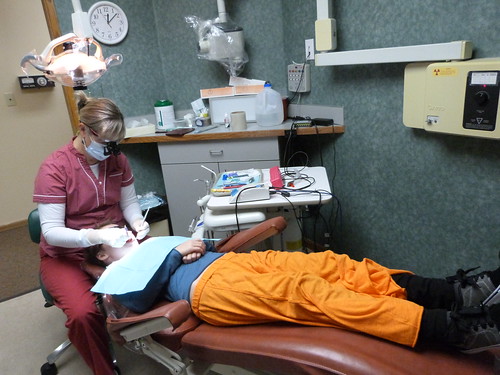
Getting talked at, while pinned down.
Today, the dental hygienist: "Do you have the day off of school?"
My nine year old daughter Phoenix: "No. I don't do school."
Hygienist: "Oh... do you homeschool?"
Phoenix: "Yes."
Hygienist: "So it's just like school, but at home!"
Phoenix: "Not really. It's quite different."
 
If you delve into almost any alternative education blog (homeschooling, unschooling, life learning, or any other related variation) you'll soon find author(s) discussing the seemingly endless querying we practitioners receive. Strangers, family, and friends regularly ask us not only to explain why and how we do things differently, but to in fact justify our life choices in a way seldom required of compulsory education adherents. More surprising still, although I admit I should no longer be surprised, many of these questioners will listen very little before proceeding to tell us how education really works, regardless of our perhaps relevant experience. Confirmation bias runs rampant and deep: often in these outsider assessments of our family life, children who give the appearance of excelling (by their manners, displayed intelligence, or skill acumen) are often labeled as "exceptions" (or "smart" or "bright", etc); while children who display any different-ness or perceived social faux pas are taken as proof that such alternative methods Don't Work (and of course, you rarely hear the compulsory schooling model being blamed for the sum and summation in the reciprocal case of a schooled child with "behavior problems", etc).
 
This is familiar ground for any family who has, with confidence, been navigating the alternative education or life learning waters.
 
We're a life learning family; radical unschoolers, if you will. For us, this means our children do not go to school and are not required to perform curriculum at home. In other words, we do nothing approximating "school at home", unless the children want to play a "school" game, which I'm just now realizing they haven't for some time. Our children are also not required to sleep at certain times or eat certain things (or forbidden others). They are not punished nor grounded when they make mistakes. They are not forced to do chores. They live with as much freedom as their father and I can afford them in safety, and any difficulties that come up are discussed as a family - and each voice has an equal say.
 
Obviously you can see this type of family model extends far beyond the scope of "education", although as many astute minds have pointed out, each of us is learning all the time, every waking (and possibly sleeping) moment. Family life is part of our education, of course.
 
So look - some time ago I gave up trying to argue why I think this is one ideal and perfectly lovely way to raise children. I am at peace with our choices; we are learning every day. Like everyone, we make mistakes and (hopefully) grow from them. My children continue to thrive emotionally, mentally, physically, and spiritually. I'm hearing daily, in relative order, how "smart", "good", "cute", "well-behaved", etc. they are. And I guess those who have negative opinions are keeping them to, or amongst, themselves.
 
So yeah, I've got nothing to prove. I'd be happy most days to just go about my thing - and let other people do theirs.
 
But you know what? The number one question my children and I hear when out and about during daytime hours is, "You have a break from school?" And every time we get that question, in some form or another, these murky waters of JUSTIFY YOUR LIFE get stirred up.
 
We have options, of course, when asked this question. We can just say "Yes." We can say we "homeschool" and let people have their imaginations (this usually involves me being perceived as doing a Lot of Work to cram information into the children's otherwise thick, clay-like noggins). Sometimes I say we "unschool". That nearly always elicits an alarmed response. Sometimes I say, "My kids don't go to school," which is usually assumed as "homeschooling" - but also, occasionally, seriously rattles grownups. I have yet to meet someone who jumps to the correct conclusion: autodidacticism, but I know some day that will happen.
 
I should point out these are the reactions I get from adults; I notice other children seem to quickly understand what our life is about. These kids have, to a soul, enthused quite a bit about a new possibility. Some children have taken a request to homeschool ("homeschool") back to their families; and a handful of these have reported on their parents' opinions of our lifestyle (probably not something those parents would be happy to know got back to us, because many times their opinions were expressed in a very Meany-Pants way).
 
I let my kids field the questions sometimes. As you can see from today's example, my daughter handled the hygienist's questions (and assumptions) quite well; but later in the day I stopped at a spa for $15 worth of a treatment I hadn't had in a couple years and within minutes, on the table, I was once again cornered. "Oh you homeschool... how fun. My sister in ______________ does it too. I know how much WORK it is. You know, kids don't just learn on their own..."
 
Ugh.
 
You know what lady? They actually do. They really do just "learn on their own", just like you and me - like regular people, almost!
 
No. Scratch that. "Uh-hmm," I say. Just please finish grooming those ferocious eyebrows of mine. Thank you.
 
It's not that I am shy about our lifestyle. I've accepted some people get upset if we mess with their worldview, just by living our life. It's that SOMETIMES I am a little tired out and I just want to have a Normal Life. "Hey Bob, how's the wife and kids?" "Fine, Jim."
 
It's tricky enough that by being a minority in this country; our lifestyle's a bit cramped as it is. A life learning advocate and mentor I respect very much describes the life learning experience as "living as if school doesn't exist". I think I know what she means by this, but of course that is not possible in the United States. Even if you didn't have strangers, friends, and family quizzing you (or outright pressuring you in hostile fashion), the 98% (or so) rate of by-rote institutionalization of children, often since infancy, has major environmental effects. Many adults don't really know how to handle kids and have all sorts of (authoritarian, Scarcity Principle) ideas. Social life is skewed in the most child-segregationist manner: other people's children are not available during the day, and due to intense scheduling, often not available for much during the afternoons, evenings, or weekends, either. When I take my children out and about, I am discouraged from having them enter public spaces - either implicitly or explicitly (I have dozens of examples in my life; here's one - in Olympia, Washington, the closest "city" to my small town, restaurants that serve alcohol - that is most of them - disallow any children to enter after ten PM, even when accompanied by their parents).
 
It's not really possible to "live as if school doesn't exist", because so many depend on it existing and do not question the order of things. And you know, a lot of days that whole business is tricky enough without the pressure of WHY WHY WHY, EXPLAIN YOURSELF.
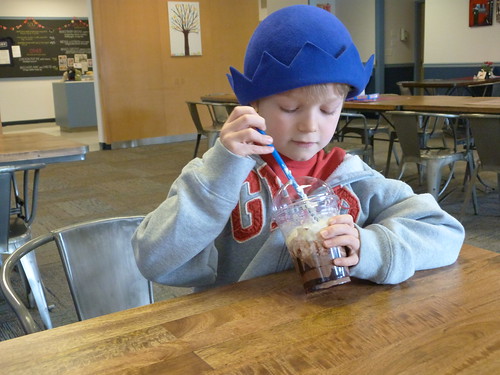
 
My son Nels, with a post dentist-visit treat. I love we get to have special dates frequently during the week.
 
So yeah, as breathlessly lovely as it's been to be exposed to, learn about, and thrive by life learning, and as excited as I am to share our journey (you can read my blog if you'd like to know more), I do sometimes get weary of being reminded we're black sheep.
 
And please don't, as my aunt once said, tell me I'm "naive" to think if I do things differently than most, I'll get treated differently.
 
You can't really say I'm "naive" when actually, No I Actually Very Much Know What It's Like to live as a minority in this way.
 
It's like - but sometimes? I. Just. Want. To. Get. My. Brows. Waxed. Or Whatever.
 
Kelly Hogaboom is a 34-year old wife, mother, seamstress, writer, volunteer, and social wellbeing activist living in lush and verdant Hoquiam, WA, the United States. She enjoys daily life with family and friends, sobriety, B-movies, and lots of snuggles with the kids and the four kitties under the roof. You can read her blog at kelly.hogaboom.org, her social wellbeing site at underbellie.com, add her on G+, and/or follow her on Twitter (@kellyhogaboom & @underbellie, resp).

Tuesday, January 10, 2012

5 Ways to Help Someone HATE Reading

I've often heard complaints and worries, from a wide variety of people, about how many people, especially youth, don't like to read.  Blame is placed on a variety of things, from texting on cell phones to uninvolved parents to class sizes in school.  But rarely is the actual way reading is taught and approached and looked at brought into question the way I think it needs to be.

I positively love reading, and have since I learned to read at 8 or 9 (and before that I loved being read to), so perhaps I'm not the best person to be writing this.  Maybe someone who actually hates reading should be writing this, instead.  But then again, people who hate reading often hate writing as well, so would probably have no interest at all in writing about why they hate reading!  Besides, I know all the things that I think  were done right to foster my own love of reading, so I figure I can just think of all the opposite things that could have been done, instead.

1. Regulated reading.  When it comes to things to read, there's an overwhelming variety.  Comic books and magazines and poetry, novels and non-fiction books and instruction manuals and textbooks.  Yet usually the only types considered Important are actual books, not magazines or video game manuals, and within the category of books there are ones considered far more respectable and important than others (for instance, fantasy novels and non-fiction books on fashion are not generally considered important to include in A Comprehensive Curriculum).  There's so much out there to read that it's virtually guaranteed everyone can find something they enjoy reading.  Yet if someone is required to read only a certain type of book, only the type of reading deemed most "educational" and "worthwhile" the one doing the requiring is infringing on whatever relationship the learner could find themselves with the written word.  Coercion breeds resentment, and deciding what someone else should be reading will likely just create resentment against both the enforcer of that should and against reading itself.

2. Required reading.  Similarly to the above, requiring people to read certain amounts or at certain times of the day or for certain reasons is a great way to make reading feel more like work.  If something can feel fun instead, that's always what people should be aiming for!  As with any forced teaching or forced "educational activities," making reading mandatory doesn't make it something fun, it makes it something to resent.

3. Book reports.  So often growing up I heard homeschoolers discussing the book reports they required their children to write upon completing any book they read.  A forced book report (something often a very unappealing thing to write even for people who usually enjoy writing) looming at the end of every completed book, is not a very good incentive to do more reading.  If you want people to like reading, it has to be something positive and enjoyable, and anything that's done to make it feel more like work is really not conducive to people learning to enjoy reading for it's own sake.  When people are most likely to not mind doing things that feel like work is when that work is freely chosen, and when it feels meaningful and important.  Book reports?  Don't necessarily feel very meaningful!  Critically discussing books can be (almost) as interesting and enjoyable as reading itself, but that discussion can happen verbally or in many different written forms (discussion groups and chat-boards, blog posts, Amazon reviews, essays, or yes, book reports) and is of course only enjoyable when the reader has freely chosen to do so.  It's also important to remember that it doesn't signify a lack of comprehension if someone is happy reading without doing any type of break-down or discussion afterwards.  Different people learn and process things in different ways, and deciding everyone is best served by writing book reports is just going to, once again, breed resentment and negativity towards reading.

4. Shaming reading choices.  Maybe a parent doesn't actually regulate as such what their children read, but exclaims upon seeing that horror novel or Superman comic in their children's hands "you're reading that??," with a healthy helping of disdain.  This can be a very passive-aggressive tactic, or it can just be a knee-jerk comment made without thought, but either way, it's not pleasant.  People want approval and support from those they share their lives with, from the smallest choices and quirks to the biggest life decisions and goals, and even those smallest comments can be hurtful.  If reading is something they have to anxiously wonder what their parents will think and say about it, it's not going to be nearly as much fun (not to mention how harmful that type of interaction is to the relationship between parent and child!).

5. Focusing on reading skill.  I say this as opposed to focusing on reading enjoyment.  Reading skills are certainly important, and certainly influence reading enjoyment (if the act of reading itself is a struggle due to learning dissability or some other reason, it's obviously not going to be very enjoyable and needs to become less of a struggle first). But when you're purely talking about reading enjoyment, as I am in this post, I'm going to say that as long as someone is able to basically read without extreme difficulty, I think it's really important not to focus on individual reading skills, and instead on enjoyment. If someone is being tested regularly, prompted to read faster, asked regularly to read aloud (as a test of ability, not for fun, since reading aloud together can be really fun, no matter what age people are!), or otherwise has a parent focus strongly on reading skills, they're turning reading into something to feel anxious and possibly inadequate about. If someone enjoys reading, that's what's important.  And if someone enjoys reading and wants to do more of it, improved skill in the activity will naturally follow!

Of course, some people will face some or all of the things on this list, and still come out as passionate and voracious readers.  This list is simply some things I think are a lot more likely to harm than help!

How is your relationship with reading?  Do you think I missed anything that should be on this list?  Chime in in the comments section and share your thoughts and experiences!

Tuesday, December 27, 2011

Against the Grain: Listen to the Podcast on The Unschooler Experiment!

I fell down on the job these last few days what with Christmas and all, but as I'm sure you'll notice my last several posts were of the essays being published on The Unschooler Experiment as part of the Week of the Idzie.  You can find a list of all those essays here, and as of today you can also listen to me read them all on The Unschooler Experiment podcast!  Check it out:


Thursday, December 22, 2011

Finding Community @ The Unschooler Experiment

Day 3 in the Week of the Idzie.

I started getting enthusiastic about the idea of unschooling when I was 16 or 17, and I actually met other unschoolers in real life for the first time when I was 17 and went to Not Back to School Camp. I think I expected everything to change instantly: that I’d magically become more outgoing and make a ton of new friends in one fell swoop, and I was a bit disappointed when that didn’t happen. But I did really like the atmosphere of camp, and I did make some new, tentative friendships. And as I continued to make my way into the unschooling community by going to a couple of conferences with my mother and sister, and going to Not Back to School Camp again the next year, I started realizing that, slowly but surely, I was making quite a few friends. I found myself keeping in touch with those friends, even though they lived far away, and gaining a hell of a lot of confidence along the way.
I learned that maybe I was someone worth being friends with, after all, and I learned that there were a lot of unschoolers I very much wanted to get to know better.
Now, the unschooling community isn’t the only one I feel I need in my life: I was rather surprised when I first started going to unschooling events by how non-radical many unschoolers are. I guess I’d assumed that because questioning the schooling system lead me to questioning so much else, that that would be the experience of others, as well. And it is! Just not as many others as maybe I’d first thought. This isn’t meant in any way as a criticism, just an honest reflection of my thoughts. Regardless, the people I choose to surround myself with now are unschoolers, anarchists, radicals, queers, hippies, pagans, and other odd folk. And I’m using “odd” here in the most complementary sense possible!
Everyone will feel pulled to find different communities, but all of us do need community.
It’s the finding of it that can be difficult.
Read more at The Unschooler Experiment.

Wednesday, December 21, 2011

Normalcy is for Squares @ The Unschooler Experiment

Day two in The Week of the Idzie.
My sister and I spend a lot of time together. We enjoy having really great discussions, sharing observations, jokes, and just generally being best friends. And a while back, I made some comment along the lines that I dress pretty normally, and my sister just looked at me and said “Idzie, you’ve forgotten what normal is.”
I regularly forget what normal is about more than just clothing. I’m not sure whether that’s a good thing or not, but I think it does say something about where, and with whom, I spend most of my time!
I’ve been asked if I feel unschooling made, and makes, it harder for me to connect with “regular” people, and I find that a difficult question to begin with, just because there are so many ways in which my views and lifestyle are, well, far from mainstream. It goes beyond just what could be covered under the label of unschooler.
Some people seem able to find common ground with every single person they come across, and I truly envy that skill. Because so often, with new acquaintances, I find myself running out of anything to talk about very, very quickly. Being the unschooling, vegetarian, animistic, green-anarchist, feminist, hippie freak that I am, what’s on my radar tends to look pretty different than the things that feature most prominently in many other peoples lives...
Read more over at The Unschooler Experiment!

Tuesday, December 20, 2011

I Get My Very Own Week, Courtesy of The Unschooler Experiment!

I did a recording of my talk Against The Current, for the wonderful website The Unschooler Experiment, about a month ago.  The Unschooler Experiment sets itself apart from pretty much all other unschooling sites in that it focuses on the stories and experiences of grown unschoolers themselves, instead of parents, and seeks to share information that's interesting and relevant to both grown unschoolers and parents of unschoolers (and grown unschooled parents of unschoolers, of course!).

And now I'm incredibly honored to be featured this whole week on that site, during The Week of the Idzie!  My talk has been broken up into 7 essays, which will be followed by my reading of those essays in a podcast on day 8.  I'm truly flattered, and also just can't help but be extremely amused by that title.  "Week of the Idzie"...  It sounds very much like something I'd declare dramatically and with great silliness to my family.  "I declare this to be the Week of the Idzie!!"  Anyway, a big thanks to Peter Kowalke and other awesome folks over at The Unschooler Experiment.

See all the Week of the Idzie posts here:


And read today's essay Against the Grain (Day 1 in the Week of the Idzie.  It seems egocentric to get such a kick out of that title, but I can't help it!). 

------------------------
In other news, though it may be taking longer than I'd hoped, posts will soon be posted on Sistermatic Response, I promise!  You can follow updates over at the Sistermatic Response Facebook page.  You can also, of course, follow this blog as well, at the I'm Unschooled. Yes, I Can Write. Facebook page!

Friday, December 16, 2011

Unschooling and Trust

When you get right down to it one of the most integral aspects of unschooling, and this is something you hear lots of unschooling advocates saying, is trust.

Trust is a really nice word.  According to Dictionary.com, trust is:

trust

 [truhst] 
noun
1. reliance on the integrity, strength, ability, surety, etc., of a person or thing; confidence.
2. confident expectation of something; hope.
I love that first definition.  Reliance on the integrity, strength, ability, surety, etc., of a person.  Unschooling, or really, doing many things differently than those ways of doing and being sanctioned by the dominant culture, takes a lot of trust.  It takes trust on multiple levels.

Trusting that Nature/evolution/the Divine/God/Goddess has created human beings capable of learning, capable of following their innate drive to learn, capable of making the important decisions in their lives.  It's trusting that nature got things right.

Trusting, as a parent, that you have the capability (and strength, ability, surety) to make the decision to take your kids out of school, or to never send them to school to begin with.  And trusting that your children are capable people, able to learn and grow guided by their innate desire to explore the world around them. 

Trusting yourself, as someone who is themselves of an age to be in compulsory schooling, to have the insight, foresight, strength and ability to take the leap of leaving school, or if your parents made that decision at an earlier point for you, trusting that you really have always been and continue to be capable of controlling your own learning, "education," and life.

Trust is hard, and learning to trust yourself is a continuous journey, full of learning and re-learning your own strength and capability, while learning to accept weaknesses and mistakes.  A great strength of unschooling is, I believe, the gift of being confident in the innate ability of children to learn.  Giving them trust.  And in so doing, breaking a cycle of teaching dependance on authority, breaking the cycle of teaching children that they're incompetent and incapable of having a major say in their own lives. 

I believe unschooling can really help in allowing people to develop confidence in their own power.

At the same time, though, unschoolers are of course just people, and unschooling doesn't erase the influences of the rest of this culture, or fundamentally change the fact that everyone, no matter their upbringing or education, has insecurities and worries and problems with trusting their own judgement.  I never went to school (I don't count kindergarten), yet that doesn't stop my insecurities!  And it doesn't stop me from wondering on a regular basis if I am trustworthy, if I really am capable of making the best choices for myself.

It helps though, having had so much trust for so many years.  It helps being able to look at all the things I've learned and accomplished, by my own initiative and in my own time. 

So, unschooling is really about trusting.  Trusting Nature, trusting your kids, trusting yourself.  It won't be perfect, but as long as that core of trust remains, I'd say unschooling works out pretty damn well.

Sunday, November 13, 2011

Guest Post: The Future of Unschooling by Jeff Landale

I found this post to be very relevant personally, as when I received it a couple of nights ago I was in the middle of writing in my unschooling book about how we present unschooling, and how I feel we often sell it short, in not recognizing how much of a truly radical impact it could have...  I feel that Jeff really illustrates some interesting and important points here, and I hope you like this post as much as I do!

The New York Times had an article it published earlier this year, titled “After Home Schooling, Pomp and Traditional Circumstances”, which, in my mind, illustrated a few of the dangers alternative education movements can encounter as they grow, and also some roadblocks to a greater role these movements can take in transforming the world. The article describes 26 Floridian homeschoolers participating in a graduation ceremony, saying that “just as more home-school families now join co-ops offering weekly field trips and chemistry labs or use the local public school for sports, band or a class, so too do many of them embrace all the trappings of graduation season.” While I don’t want to deny parents the joy of seeing their child participate in a ritual marking their entry into the world (especially given the overall lack of rituals we have in our world), I hesitate when I see alternative education taking the same path that alternative music took in the 90s: a different surface aesthetic, but fundamentally following the same model as what it was ostensibly supposed to be an alternative to.

The article describes how each graduate was given a “Certificate of Completion”, speeches were given, photographs were taken of the graduates in gowns and those square hats with the tassels, so that the homeschoolers can say “I graduated, just like everybody else.” Homeschooling, for these homeschoolers and their parents, seems to be a way of schooling, just by other means: parents instead of teachers, a graduation at the zoo instead of the gymnasium, and so on. By wanting to participate in the cultural touchstone of a graduation ceremony, these homeschoolers are still allied to the ethos of school. There is thus only a superficial rejection of schooling, because the school is simply reconstructed at home. For the students and parents, this can make a huge difference in their lives, but structurally things are the same. Homeschooling, in this way, is a private affair, and a private decision, with no implicit or explicit social ramifications.

While this article does not make a big deal about the pros and cons of homeschooling (Will they be socialized? Will they have friends? How will they live in the real world? Will they learn anything?), it does open up the possibility that these questions are increasingly becoming an irrelevant distraction for people interested in truly radical alternative modes of education. If homeschoolers spend so much time and effort imitating the rituals, structures, symbols, and outcomes of industrialized compulsory education, if homeschoolers work hard to be able to answer the mind-numbing litany of inquiries into the success of homeschooling, then homeschooling itself will be nothing more than school outside of the school building.

And this is where Unschooling comes in. Unschooling runs the same risk of becoming superficially different while structurally similar to the forms of education and learning which we are aiming to break free from. Unschooling as a pedagogical philosophy has the advantage of being able to differentiate itself from both industrial schooling and homeschooling, but only if it differentiates itself critically, and not merely superficially. What are the structural changes we want to see in our lives as a result of Unschooling? What kind of relationship do we want with learning? What are the social changes that would inevitably result from Unschooling, if the logic of the philosophy was allowed to unfurl itself completely?

Writers like John Taylor Gatto (Dumbing Us Down) and Ivan Illich (Deschooling Society) showed not only how schooling damages individuals, but also how it supports so many of the oppressive and exploitative aspects of our society. If we find ourselves engaging in radical modes of alternative education which don’t inherently challenge and disrupt crucial aspects of the world, then we should be concerned that we are actually reproducing the same structures which Unschooling was originally supposed to allow us to escape from. Thus, rather than having Unschooling be that thing which isn’t school or homeschooling, we should have Unschooling be something which, while growing out of critiques of industrial schooling and its sibling, homeschooling, defined in terms of what it allows us to become, and how it allows us to change the world. And this means that in a lot of cases, we should simply disengage from conversations with Unschoolers and with all of those annoying talking heads on TV who ask over and over again whether Unschooling will create the same sort of individuals as school does (except smarter, and harder working, or whatever). With the legal status of Unschooling being mostly settled in the United States and Canada, now might be the time to stop reassuring others and ourselves that Unschooling won’t screw up lots of kids, and start focusing on how self-directed learning can lead to, and be a part of, much broader social movements throughout the globe.

Jeff Landale is an elementary school drop out currently studying Politics and Classics at Simon's Rock College in scenic Great Barrington, Massachusetts. Ostensibly, he is writing an undergraduate thesis on Unschooling and its role in emancipatory struggles, but in reality he spends his time thinking about Indian food. He can be reached at jefflandale@gmail.com

Friday, October 14, 2011

Unschooling: Are We Teaching Ourselves?

Virtually every time unschooling is covered in the media (such as the newest segment on MSNBC's Today Show) people, either in the segment itself or in the comments, refer to unschooling as an educational "method" where kids "teach themselves."  And that's always struck me as being way off the mark.  Unschooling isn't about unschoolers "teaching themselves": it's about unschoolers choosing how and what and with whom they want to learn.

The world is big, and we're constantly learning.  Sometimes the learning happens when you're alone, sometimes with just one other person, sometimes in a large group.  These are just a few ways that unschoolers can and do find knowledge and learning:

The internet and books.  Here is a way that could be considered "teaching yourself."  Looking up things you're interested in on the net, reading books on the subject...  Yet even that isn't necessarily an all-by-yourself thing.  Sometimes someone will read something out loud to me that they think I might be interested in.  I regularly share article links and in turn have people send me links.  I interact with people and learn from them on the internet quite often.  I visit the library or a second-hand bookstore with family and friends, and we share the interesting books we find. 

Classes and lessons.  I know, shocking, isn't it?  But Unschoolers do actually take classes sometimes!  My sister takes Ninjitsu and has music lessons.  I've gone to various classes in the past.  Many unschoolers do, because sometimes, they're just the best or easiest, most interesting or fun way to learn something new, improve a skill you already have, or just enjoy learning along with a bunch of other people!

Workshops.  I could have included workshops with classes, I suppose, but I wanted to put this separately because I feel like most of the time, workshops  have a different feel from classes: they're more horizontal, rooted in the community, have less of a here-is-an-expert-teaching-us-stuff and more of a here-is-a-member-of-the-community-sharing-knowledge feel.  In case you couldn't guess, workshops are one of my favourite ways to learn with others, share knowledge, have great discussions, and meet new people.

Mentors.  My sister's Ninjitsu instructor and drum teacher are both most definitely mentors.  They're people she's friends with, people she respects, and people she learns a lot from (and as in all healthy relationships, no matter the type, I imagine they learn from her, as well).  Mentors can be found through formal things like classes, as well as informally, through your community or extended social network.  But no matter how you find them, people who are passionate and knowledgeable about something (be they accredited teachers or not), and are happy to share that knowledge and experience with others, can be a really wonderful way to learn.

Talking to people.  Everyone has skills and knowledge and things to share.  If you simply talk to people--friends, family, acquaintances, strangers--you learn a lot about a lot of different things.

The whole damn world.  I think that when people are first learning about unschooling, it can be helpful to point out specific ways to find knowledge and gain skills, but when it really comes down to it, learning is everywhere.  Whether walking in the woods, reading a book on architecture, going to Spanish class, talking to a friend, or contemplating clouds, learning is happening.  And I think that's one of the biggest paradigm shifts people make as they move towards unschooling: seeing that learning happens everywhere, all the time, not just between certain times in the day, or when engaging in certain activities.

Occasionally (really, it doesn't happen often), I've heard people say that they think that children are fine growing up with only their family unit around them: that all that kids need is a stable, loving family, and I definitely disagree with that.  While I think family is/can be extremely important, humans are social animals, and I believe having a wider community is also extremely important (and I also want to acknowledge that for some people--children and adults--who do not have any family, or whose family is not loving or supportive, people from their community are the most important people in their life).  So I think that by looking at unschooling as something done by a child, alone, that's really inaccurate, and misses out on what I think can be one of the best things about unschooling: the fact you're living in the actual world, interacting with lots of different people, learning and discovering within your family, and within your community. 

So, sometimes unschoolers learn on their own.  Sometimes they don't.  Some unschoolers spend more time learning with others, some unschoolers spend more time learning alone.  But overall?  Unschooling definitely isn't about only ever "teaching yourself"!