Showing posts with label books. Show all posts

Friday, January 4, 2019

Ending the Tyranny of the Classics

I’m someone who loves to read, loves books with a depth of feeling I find hard to convey in words. If you’re a fellow book lover, you know what I mean. But I’m also a reading rebel, of a sort, who believes strongly in people’s right to develop their own relationships with stories, read what they want, or not read at all. Prescriptivism only ever gets in the way of enjoyment.
__

We pick our way through prickly grass, shriveled and brown from an excess of sun and shortage of rain, shake out our slightly musty lawn chairs, and settle in front of the stage, a simple fake-stone structure serving as backdrop to one of the most well-known plays in the Western canon.

My mother used to bring me and my sister to see a Shakespeare-in-the-Park show every summer when we were growing up, and after years of missing it, I’ve picked up the tradition once more as an adult. Two years ago the production was an all-women version of Julius Caesar. Last year it was a 50’s themed take on Much Ado About Nothing. And this year, a very queer Romeo and Juliet. Our local theater company that puts on these productions likes to do something fresh and modern with such well-worn material, as many great modern Shakespeare companies do. They’re also incredibly skilled, the actors featured often winning awards for their performances.

I’m watching the performance with my sister, who’s long been in love with both musical theater and Shakespeare. She’s watched the recording of the 2014 Donmar Warehouse production of Coriolanus multiple times, and tries to convince all her friends to see it, too. She once drove 2 ½ hours to Ottawa to see a National Theatre Live show that wasn’t going to be airing in our home city of Montreal. When she was backpacking in the UK, a highlight of London was seeing a production of Macbeth at the Globe Theatre.

I, on the other hand, am a much more casual fan. For the most part I’m purely a Shakespeare-in-the-Park person.

Romeo & Juliet: Love Is Love, put on by Repercussion Theatre.

Needless to say, we were never taught Shakespeare in a formal context. We were never forced to read plays, of all things--an exercise about as useful as teaching kids to read music so they can study the scores, instead of going to a concert. But when something so permeates a culture as does the works of Shakespeare, and when you live a life filled with books and media and other human beings, it’s impossible not to bump up against countless references that give you basic outlines of what you’re missing, or lead you to dig into the topic further, to understand for yourself why your culture has become so saturated with these works of art, and whether you think all the fuss is worth it or not

As my sister and I headed home from the play, shirts buttoned up against the surprisingly chilly summer evening, we were laughing about some of our favourite amusing bits (from the first half, before everything becomes tragic) and discussing the thematic relevance of making Romeo and Juliet a lesbian couple, with parents hell bent on their children only partnering with the “right” people. Sometimes classic works can really be imbued with a sense of timelessness, and bring joy to people long, long after their creators could have ever imagined.
__

When I first started this post, I was thinking of “the classics” as the Western canon generally foisted upon high school students. But I quickly branched out to cover “classics of the genre,” and just anything that’s held up as classic in one way or another. The works people place on a pedestal. The ones people are told they have to read.

There’s a devotion in our culture to those canons, an awe felt towards works that have, as far as I can tell, been chosen as best somewhat arbitrarily. It’s not that classics aren’t generally good in some way (though some are, in my opinion, genuinely bad and just dressed up in enough pretension to fool people who aren’t looking too closely), but best? Out of everything countless people have created and produced and shared? When it comes to art and literature, I don’t think there is such a thing as “best,” a judgement that’s just far too subjective.
__

My family’s home has always been filled with scores of science fiction and fantasy paperbacks. It’s easily the most popular genre in this house. And as I reached the beginnings of my teens and started looking towards adult books, I tried picking up some of the supposed sci-fi greats, people you’d surely recognize even if you're not a reader of the genre yourself, like Isaac Asimov, Robert Heinlein, and Arthur C. Clarke. And that’s the first time I can remember questioning the place of “classics,” and whether the works endowed with such a title were really so deserving of my time.

There’s a certain way that those male writers talk about women, and though I didn’t have the vocabulary or understanding back then to fully recognize why those books I attempted to read (and often gave up on) made me uncomfortable, I now know the simple reason is “misogyny.” Undaunted, I dove into genre fiction, preferring the fantasy end of the spectrum, and gravitating towards newer releases.

I’ve been loving SFF for many years now, choosing my reading material primarily from the ranks of genre fiction, but I found that same frustration I had all those years ago with big-name male writers creeping back in. Time and time again I’d read stories by very well respected male authors and find that the women characters were nothing but props and prizes or cartoon villains, cardboard cut-outs of straight male fantasies or “bad” women who didn’t perform femininity “correctly.” To say I was becoming disillusioned with all of those writers held up as masters, who seemed completely incapable of writing interesting women with engaging storylines, would be an understatement.

This Christmas I was gifted with a favourite, and somewhat obscure, fantasy
trilogy: The Fall of Ile-Rien by Martha Wells. An author who writes amazing
characters of all genders!

This is emblematic not only of sci-fi and fantasy, but of the majority of what are held up as great literary works, books that are strikingly white, male, and straight, and tend to have embedded in their pages either a callous disregard for or outright animosity towards all those people who aren’t white, or male, or straight. In Erin Spampinato’s piece How does the literary canon reinforce the logic of the incel? she questions what topics have been enshrined in our collective psyche as important:

“I was trained to accept that male sexual frustration was a serious issue because I read hundreds of pages about it before the age of 20, far more than I read about issues of undoubtedly greater social import, like the legacy of slavery, the alienation of women and people of color from public life, or the violence of the settler colonialism on which the United States was founded. Perhaps these novels even coached me into taking male sexual frustration seriously through a kind of frightful education: look what happens, they seemed to say, when men don’t get what they want. “

For myself, I just decided several years ago that my reading world would be richer and more rewarding if I severely cut down on authors most likely to write terribly about women (aka men), and I have never looked back. I haven’t cut out books by men completely: I still read some books by male authors I already know I like, books by marginalized men, and books by men that have been recommended by people whose taste I trust. But to put it in perspective, I’ve read more books this year by nonbinary authors than by men, and out of the 55 books I read in 2017 only 4 were by men.

I imagine this choice will strike some people as unfair, but I have only so much time to read, only so many books I can read in my lifetime, and each book I choose to read means another book left unread. Each book that leaves me disappointed is time that could have been spent on something that enchants me instead. My parameters for choosing books are designed to prioritize the books I think I’m most likely to like, and my experience has taught me that I generally prefer books by people who aren’t men. So that is what I read.

I also almost exclusively read newer books, those published in the last fifteen years or so. It brings me great joy to stay on top of new releases in my chosen genres, to read books that are extraordinarily timely (as they’re products of the world we are currently living in), and ones that will likely end up on the ballots of my favorite awards. I’m constantly asking my library to purchase new and upcoming books, and delight in discovering promising emerging authors. In choosing to focus on newer books, I also read more diverse books, since the industry is changing and the authors who used to get shut out--authors of colour, queer and trans authors--are at least starting to be recognized.
__

As I mentioned previously, there can be a lot of gatekeeping in the SFF genre (and, I imagine, other genres as well), with ideas that you have to start with “the classics” when entering a genre. That you have to read Tolkein if you want to read fantasy. I almost finished The Hobbit. The Lord of the Rings trilogy bored me immensely, meaning I never finished the first book, and if I’d believed those gatekeepers back in the day, the ones who say there’s only one door that everyone must pass through, I would have missed out on an entire world of literature that makes my heart sing.

As bestselling fantasy author V. E. Schwab has said about her own disinterest in Tolkein, “I have a very strong belief that reading should be an act of love, of joy, of willing discovery. That when we force someone across the wrong literary threshold, we risk turning them away instead of ushering them through.” (That linked article is well worth reading in full, by the way.)

Or, as another successful SFF author, John Scalzi, put it on Twitter, “Most ‘classics of the genre’ (whatever the genre) are just unbelievably dated and anyone who demands new readers to genre ‘start with the classics’ is going to ensure they hate it. Give new readers new books they have a better chance of relating to. They can work backward later.”
__

I tried reading Jane Eyre at some point in my teens, and was deeply bored. I picked up a couple of other very old books in my teens and found myself similarly uninterested. It’s only this year, after diving into the world of modern historical romance, that I decided it might be time to give some books by Jane Austen a try. An audiobook would be a good medium to tackle such a novel, I decided, and I picked a narrator I was familiar with, one I knew I liked, out of the dozens, perhaps hundreds of recorded versions. I know the story of Pride and Prejudice quite well thanks to countless film and book riffs on the story, and I’m happy to say I’m enjoying it! The immersion in a different time period, the sly humor, the differences in story construction between a Georgian and modern novel. It’s not that I’ve decided everything old is bad, just that newer generally means more relevant, unless you’re specifically interested in understanding the history of a genre, or a time period.
__

If someone came to me and said “I want to start reading SFF. Where should I start?” by now it should surprise no one that I’d pull out modern suggestions, by women, as my top picks. Something by N. K. Jemisin, either The Hundred Thousand Kingdoms or The Fifth Season, depending on how dark and complex a read someone was looking for. The Ancillary series by Ann Leckie, for certain. I’d say they should definitely pick up something by Naomi Novik and Martha Wells. I’d make sure to note some new authors to watch, like Ruthanna Emrys and Rebecca Roanhorse, C. L. Polk and Alexandra Rowland. I’d let them know about some of my very favourite series, like Wayward Children by Seanan McGuire, and the Spiritwalker trilogy by Kate Elliott.

But I’d also be very sure to make it clear that my beloved books might not be theirs, that the experience I’ve built in the genre is tailored specifically to me, to my interests, to the themes I find captivating. Maybe they would like entirely different authors, different stories, different experiences.

A statue I came across in Quebec City, by the
sculptor Rose-Aimée Bélanger

__

My argument against attempting to force anyone, children most definitely included, to read “classics” feels like a very personal one to me: I don’t read many, and I’m fine. But going deeper than that, I credit not being forced to read things other people decided were best for me with allowing me the space to find what I, personally, loved about books and reading. I wasn’t turned off of reading, or turned off of a certain genre or type of book, by being forced across a threshold that was not meant for me. Letting people come to things in their own time, when and if they want to, allows them to figure out what’s right for them, which parts of the literary world they wish to explore and which parts they want to steer clear of. 

In trying to force the same set of books on everyone, you push people towards things that most will find irrelevant, outdated, and not at all in line with their interests. You turn what could be something positive for some percentage of those people into a chore instead.

There’s a big difference between introducing works you think are interesting and important, and deciding to dictate to another person what they themselves should like and care about. In the relentless amplifying of so-called classics, too many people fall into the latter category.

The world of books and reading can be a fantastic one to explore. Lets stop ruining it for others by insisting there’s only one path to take.

Monday, June 4, 2018

The History in Historicals: Learning Wherever Interest Takes You

I spend a lot of time talking about how ever present learning is, and how learning doesn’t have to look like schooling in order to be valuable. I also believe that fun and leisure are perfectly good pursuits all on their own, whether they lead to learning or not (and they almost certainly will, anyway).

But I also think it can be helpful every now and then to discuss examples of learning that looks “educational,” found in places that may be unexpected.


In the last few months I’ve been reading what’s certainly the most maligned of the broader historical fiction category: historical romance. People like to make snide comments about “bodice rippers,” and disapproving comments about what sort of people would read such “trashy” non-literature. Yet I’ve been not only enjoying the genre immensely, but also learning a lot. Shocking, I know! While books within the genre range from quite thoroughly researched and historically rooted to what’s perhaps best described as anachronistic, they’ve all lead to a whole lot of historical fact gathering. Thanks to my friend Google, I’ve been looking things up multiple times for every book I read, seeing what is and isn’t accurate, figuring out when exactly a story is set, and falling down rabbit holes in pursuit of more details about a particularly fascinating event or topic.

An incomplete list of things I have looked up and learned something about in the past four months of romance reading, in no particular order:

When (and where and for whom) wigs were fashionable; the British political party of the Whigs; the various “eras” in British history and where they start/end/overlap (Georgian, Regency, Victorian, Edwardian); the evolution of bustles and bonnets; the Peterloo Massacre and the Six Acts; the Cato Street Rebellion; the Corn Laws; history of condoms from earliest examples to mass production; bloodletting and the theories behind it; when the link between hygiene and infectious diseases was first made; what railway surgeons were; history of “sodomy” and other anti-gay laws in the UK, France, and North America; Regency era sex clubs; British nobility, all the ranks and rules around titles and courtesy titles; the differences between various horse-drawn conveyances; Mary Wollstonecraft and the Vindication of the Rights of Women; history of epilepsy and treatment of epileptic people; the anti-slavery sugar boycotts of the 18th and 19th centuries...

Even the staunchest supporters of learning-that-looks-like-schooling couldn’t find fault with studying history, and all of this gaining of greater understanding of the United Kingdom in Georgian through Victorian eras is thanks to the humble historical romance novel.

Constant curiosity, the drive to look things up, discuss and consider, is in large part an innate human quality… Though it can, of course, be discouraged and suppressed. Even when that’s the case, cultivating a practice and lifestyle of curiosity can be done, by paying attention to those sparks, the ideas or comments or facts that our brains get snagged on, and seeing where it goes. It helps not to put pressure on yourself to make a passing interest into something it’s not: a passion. There’s no need to force it, just follow it for as long as you’re eager to do so, and veer off down a different path when the mood takes you. Unless you have a specific reason for sticking with something past that point (and if you do have a compelling reason, go you!), there’s no need to do so.

I’m quickly becoming almost as enamored with historical romance as I’ve been of fantasy fiction for the last 15+ years, and novels in general definitely merit a passionate interest rating from me. But my online historical fact-finding missions don’t usually go very deep: I’m content to know important dates and make connections between different political events and movements without feeling a need to check out six books on the appropriate topics from the library. What’s important to me is that I keep on reading what I like to read, researching where curiosity prompts me to do so, and just enjoying going wherever life learning takes me.

Tuesday, February 6, 2018

Why Assigning Books or Reading Time is a Bad Idea

This post was originally shared on Patreon back in October. I can't emphasize enough how big a difference my monthly Patreon income, small as it might be, makes in my life. Seriously, by investing $1 or more a month in me and my work you can have such an impact. And you also get extra posts, like the one below, most of which will never end up on this main blog, some of which will end up here many months after their original Patreon publication date. So please consider becoming a financial supporter, and whether you do or not, I hope you enjoy this taste of what I share with Patrons!

I don’t think children should be assigned specific books. I also don’t think children should be assigned specific reading times or amounts. Basically? I don’t think that reading should ever be compulsory.

Some of the biggest pushback I get when I say this is from people who fondly remember the works they were introduced to thanks to assignments in English class: If I hadn’t had to read Pride and Prejudice I probably never would have. I’m glad to hear of people discovering Things They Love, in whatever way they do. However, I find the underlying assumption that coercion is the best way to force someone to love something to be troubling, to say the least.


Compulsion is not the best way to create passion. This one should be obvious, really. For everyone who loves a book they were assigned in school, there are probably at minimum two other people who hated it, and decided they’d never go near that author again (or never touch another classic, or in some cases just avoid reading altogether). Humans as a whole do not react well to being forced to do things they don’t want to do, and often develop a strong resistance to the subject or thing they are being coerced into doing.

Compulsion shows a fundamental distrust of the child. “I know what’s best for you to do, so you should do it and like it.” Nowhere in an assigned reading list is there room for a child to make their own decisions, to explore what they’re most drawn to. And there’s little more room for a child to set their own pace, their own priorities, and their own goals within assigned reading times or logs, which turn what should be something joyful into a chore. Every piece of a child’s learning that is taken out of their hands is another signal to them that they are incompetent, untrustworthy, and incapable of learning on their own, which is such a sad message to be sending children.

Sharing really is caring. Enthusiasm is often infectious. If there are books that had a big impact on someone in their formative years, or that seem culturally important, or that they think a kid will like, it’s great to suggest reading it, to borrow it from the library and leave in a stack of books-I-think-you’ll-like, to initiate a read-aloud...It’s definitely the role of adults in children’s lives to expose them to things, to make suggestions, to share passions. But all that can be done without bringing coercion into the mix.


Developing a personal relationship with stories. As someone who really, deeply loves novels, who comes from a family of readers, I feel very strongly about the importance of individuals developing their own unique relationships with literature and more broadly with the written word (or spoken word! Audiobooks are great if that’s your jam). As all of us who love books know, they can be truly magical, but only if they remain an enticing option, and not the brussel sprouts of the learning world: do it because it’s good for you, not because it tastes good.

Ultimately, no one has control over what another person will like, or love, or be curious or passionate about. All you ever have is influence, and when used both enthusiastically and respectfully, you have the power to introduce exciting and beautiful things into the lives of children… Without compulsion.

Thursday, January 4, 2018

My Favourite Novels of 2017

I think it’s fair to say 2017 has been a difficult year for a lot of us, both on the world stage and in our personal lives. And for me, no matter how much I’m struggling with depression, no matter how bleak things are looking, books are a source of comfort, a way to grapple with difficult topics in more removed settings, a strange glimpse of other possibilities… And I wanted to share some of my very favorite novels from the past year. They’re all sci-fi or fantasy (because that’s what I love best), but within those genres they vary wildly, from historical fiction with just a sprinkling of magic, portal fantasy that’s just as much literary exploration of identity and abuse, a fast-paced murder mystery in space, and a series of linked short stories that act as a damning critique of the way women are too frequently used and discarded in the superhero comic genre. I tend to read both young adult and adult fiction without distinguishing much between the two, and I believe this list contains about a 50/50 split (I’m not sure how a couple of the titles were marketed). I hope you’ll find something here to love as much as I did!


Six Wakes by Mur Lafferty
A murder mystery on a generation starship starring clones with missing memories, this is the definition of a page-turner. I think I finished it in under two days. The pieces come together for you as the reader at the same time as for the protagonists, giving you a genuine chance to solve the mystery, and skilled use of flashbacks serve to propel the plot forward instead of feeling like a frustrating diversion. This is very much a plot focused story, and the characters, though some are intriguing, never have all that much depth. But all in all, a very enjoyable read.


Dusk or Dark or Dawn or Day by Seanan McGuire
A beautiful little novella about a ghost who just can’t seem to forgive herself for either her own death or that of her sister--so she sticks around, takes in very old cats, and works at a suicide crisis call center. But when other ghosts suddenly start disappearing, she realizes she needs to help her fellow undead, and in the process learns how to finally forgive herself. Fast-paced, but also wistful, lyrical, and moving… A lovely story.
“The world is full of stories, and no matter how much time we spend in it—alive or dead—there’s never time to learn them all. They just go by so quickly.”
― Seanan McGuire, Dusk or Dark or Dawn or Day

All Systems Red by Martha Wells
Continuing with novellas (this year I read quite a few good ones), Martha Wells’ new sci-fi adventure is definitely worth checking out. This is the story of an AI who, unbeknownst to its owners, hacked it’s “governor” program in order to gain independence, a limited freedom which it mostly uses to watch soap operas. Because robot or not, Murderbot (as it named itself) has some serious social anxiety, and is generally much more concerned with being left alone than with murder. But when the small exploratory team on a remote planet that it’s assigned to protect start encountering strange problems, and the signals from nearby settlements go dead, Murderbot puts itself right in the path of danger for the people it’s reluctantly started to actually like… Funny, sweet, and full of suspense, I can’t wait to read more about the surprisingly charming Murderbot in future installments of this series.


Winter Tide by Ruthanna Emrys
It’s been a long time since such a quiet, slow novel pulled me in so easily and completely. When I say quiet, I definitely do not mean dull! Over two decades before the start of this book, the US government became aware of the “Deep Ones,” a small community of people who, as they age, transform into aquatic beings who slip into the ocean depths to spend their remaining millenia. Spurred on by malicious rumours and fear of their strange powers, the government rounded them up and imprisoned them in concentration camps far from their ocean home, where due to neglect and violence both, one by one they died. This is the story of one of the only two survivors, Aphra, who’s reluctantly drawn into an investigation of the potential use of magic by the Russians. Far from a spy novel, this is instead a thoughtful and very real-feeling exploration of prejudice, trauma, family, and recovery. An excellent debut novel by an author I will now be following closely.


The Gentleman's Guide to Vice and Virtue by Mackenzi Lee
It’s been a long time since I’ve read a novel that’s such pure fun! A historical adventure of a romp across 18th century europe, this story follows Monty, an unrepentant rogue, his best friend Percy, whom he just happens to be hopelessly in love with, and Felicity, his peskily sensible younger sister, as he savors what will likely be his last taste of freedom on his Grand Tour. But things take a turn for the dangerous when he sort of accidentally steals something precious, and the trio is forced to go on the run. While grappling with their feelings for each other, and how to find their place in a world that’s often very unfriendly to our characters (who are queer, multiracial, disabled/chronically ill, and have the wrong pursuits for a woman), this story is ultimately sweet, hopeful, and all around delightful.
“God bless the book people for their boundless knowledge absorbed from having words instead of friends.”
― Mackenzi Lee, The Gentleman's Guide to Vice and Virtue

Down Among the Sticks and Bones by Seanan McGuire
An achingly sad novella, one that almost reads like a cautionary fairy tale on what happens when children aren't allowed to be themselves, when parental expectations become so huge, so crushing, that they break something, perhaps irreparably, in the small humans at their mercy. It's an exploration of abuse, and what it can do to someone. It's also a strange story about a strange world, one filled with mad scientists and vampire lords, a red moon and endless moors. One where blood and fear are an everyday companion. With that in mind, it says something that the part of the book which takes place in our world remains the most disturbing. It also says something that Seanan McGuire is the only author to show up twice on this list. She is an absolute master of the novella format, and I will read every single one she writes with great joy. Highly recommended, if you're up for something thoughtful, dark, and moving.
"It can be easy, when looking at children from the outside, to believe that they are things, dolls designed and programmed by their parents to behave in one manner, following one set of rules. It can be easy, when standing on the lofty shores of adulthood, not to remember that every adult was once a child, with ideas and ambitions of their own."
― Seanan McGuire, Down Among the Sticks and Bones

Jane, Unlimited by Kristin Cashore
I’m sure I’ve said before how much I admire originality in my fantasy novels, seeing as I read so many of them, and this one here? Does not disappoint! On the surface, this is a story about a young woman, Jane, grieving the death of her aunt and surrogate parent, who accepts an invitation to a mysterious mansion. But things quickly start becoming more surreal, and more strange… How different would things be if you made a different choice? Or a different one? Or a different one? Many paths unfold, possibilities both bizarre and terrifying, as Jane seeks to better understand herself and her place in the world. Highly recommended.
“People tell you that what happens to you is a direct result of the choices you make, but that's not fair. Half the time, you don't even realize that the choice you're about to make is significant.”
― Kristin Cashore, Jane, Unlimited

The Refrigerator Monologues by Catherynne M. Valente
This linked collection of short stories is surreal, furious, and sad. There are no happy endings here, as what unites the women protagonists is that they were all either the wives or girlfriends of superheroes (or supervillains) or superheroes in their own right, and that now they’re all dead. Taking direct aim at the “fridging” of women in the superhero genre in order to further the stories of men, this combination novella and anthology is disturbing and captivating.

Buried Heart by Kate Elliott
This is the only book on the list that’s not the first in series or a standalone. Instead, it completes a series which began with Court of Fives, about young athlete Jes, though in this novel the athletics are in short supply. Civil war has broken out as various colonizing Patron factions vie for the throne, and revolution is brewing as the Commoners look to take advantage of the disarray to once more claim control of their own country. Jes’ growth through the previous two novels has been a pleasure to watch, but that pales in comparison to this final instalment, where we see her truly come into her own, and finally realize she has to start picking sides and taking stands. Seeing the surprising roles her whole family play in the rebellion was also one of my favorite parts of this book, and it felt very fitting, because such big themes throughout have been family, loyalty, and doing what’s right. All in all a very good conclusion to a very good series, and as always, I can’t wait to see what Kate Elliott comes out with next.

Honorable mentions, aka beloved series published previous years that I enjoyed re-reading this past year: The Fall of Ile-Rien series by Martha Wells, The Raven Cycle by Maggie Stiefvater, The Spiritwalker trilogy by Kate Elliott.

Friday, December 30, 2016

The Best Young Adult Fantasy Novels of 2016

I know, I know, this isn’t exactly a post about unschooling. And on an unschooling blog no less! How could I? But as the year comes to a close, and I look at my list of books I’ve read in 2016 on Goodreads, I wanted to share some of my young adult fantasy favorites. Why this genre, in particular? Because fantasy (aimed at both teens and adults) makes up at least 90% of what I read, and because I thought some of you might appreciate some good recent books about young people doing extraordinary things. Each of the novels that made it onto my list is the latest in a series, so essentially I’m reviewing each series rather than each book, and I’ve listed the books which came previously--and which were not published in 2016--in brackets. I hope, if you choose to check out any of these books from your local library, that you’ll enjoy them as much as I did!

Poisoned Blade (Court of Fives) by Kate Elliott


Kate Elliott has long been a favorite of mine thanks to her Spiritwalker series, so when she made her first foray into the world of YA fiction with Court of Fives last year, I eagerly snatched it up! And neither that novel, or this year’s follow-up, dissapoint. Our protagonist, Jessamy, wants nothing more than to compete in the dangerous and prestigious Court of Fives, a competitive obstacle course popular with all levels of society. An athlete through and through, she doesn’t want to have to worry about politics. But having been born to--and, shockingly, acknowledged by--a high ranking Patron soldier, member of the ruling class and race, and a Commoner mother, a colonized and oppressed racial group in this Roman-esque empire, for Jess her very existence is political, a fact she just can’t escape. Because change is brewing. Rebellion is simmering amongst a people desperate to hold onto and reclaim their culture; deadly political maneuvering is taking place in the highest tiers of power; and war is approaching with neighboring countries. Jess must carefully make her way in this fraught landscape, striving to protect her family and make the right choices when there are no good choices. More tightly plotted and faster paced than Kate Elliott’s adult novels, I look forward to the next installment.

Reader discretion: Some rather disturbing/gory violence; reference to and threat of sexual abuse/violence; the murder of children.

A Torch Against the Night (An Ember in the Ashes) by Sabaa Tahir


Whereas the above series takes place in a carefully drawn world with distinct cultures, Sabaa Tahir’s world, though similar in some ways to that of the Court of Fives series, feels like the world is simply sketched in. A staged setting where, while a couple of elements might stand out, the majority fades into the background. While that might not be something I’d usually excuse, I can overlook it in this series because the story itself feels meticulously built: Tahir isn’t flying by the seat of her pants, she knows where this story is going. And let me tell you, where it’s going is some pretty dark and brutal places! The viewpoint characters, Laia and Elias (in the second book a third viewpoint is introduced) could not come from more different backgrounds. Laia is born to the Scholars, a conquered people now brutally oppressed by the Empire, and Elias, taken as a child to be trained as a member of the elite soldiers/interrogators/assassins known as Masks, is a bitter and deeply reluctant tool of the Empire itself. When Laia’s family is torn apart, she makes the desperate decision to become a slave and spy, and as her and Elias’ paths cross and their lives become tangled together, they both have to find their own kind of strengths, and figure out just what sacrifices they’re willing to make--and what horrors they’re willing to commit--in order to survive, save those they love, and try their best to do right. This is one of these extremely grim, dark stories with truly horrible things happening pretty much constantly, but which still manages to have hopeful threads throughout. The characters and plot both are extremely compelling, and these books have stuck in my head long after I finished reading them... I really hope the bright spots are built on in the final novel(s?) so that the darkness doesn’t feel completely overwhelming.

Reader discretion: Torture (of both adults and children, including viewpoint characters); murder (again, of both adults and children); slavery; genocide (yes, really); attempted rape.


Crooked Kingdom (Six of Crows) by Leigh Bardugo


Six of Crows sets itself utterly apart by being something I almost never see in fantasy fiction: a heist novel, complete with a mastermind criminal who’s always thinking several steps ahead of everyone else; a sharpshooter with a gambling problem; the best spy (and thief, and occasional assassin) in the city; an incredibly dangerous magic user; an explosives expert with a secret; and an ex-soldier and (mostly ex) zealot who’s roped into all of this very much against his will. Members of an up-and-coming street gang in the bustling mercantile city of Ketterdam, all of them are hand picked by the aforementioned mastermind to travel across the sea in order to steal something of immense value and dangerous political ramifications… Following their theft and all that comes after it, this series is fast-paced, quite dark, often funny, and all around delightful. Watching the bonds develop and deepen between these characters is a real pleasure, and I hope to see more of them in future novels.

Reader discretion: Gore, torture, murder, reference to past sexual abuse/rape, all involving children and teens.

A Gathering of Shadows (A Darker Shade of Magic) by V. E. Schwab


Take multiple Londons (grey London, with no magic; red London, steeped in magic; white London, vicious and starving; and black London, shut off from the others lest it consume them all); a rare traveler able to move between worlds; and a ruthlessly ambitious cross-dressing thief with dreams of becoming a pirate, and you end up with this series. Forming a slightly uneasy truce, world-traveler Kell and thief Lilah must work together to stop a creepy body stealing being, defeat a desperate sorcerer, discover the true nature and limits of their respective magic, and find their own place in the worlds. Though the first book started off a bit slow in my opinion, once I got into it, I was hooked. I positively adore mean and prickly Lilah, and I’m pretty darn fond of brooding Kell and his beloved and rather dramatic brother Rhy (who gains a whole lot of greatly appreciated complexity as the series progresses). In many ways this is classic fantasy: dark sorcerers and evil worlds and the like, but there’s so much about it that feels fresh and original, and I very much appreciate V. E. Schwab’s distinctive voice.

Reader discretion: Attempted rape, murder, torture, creepy body stealing being, mind control.

The Raven King (The Raven Boys; The Dream Thieves; Blue Lily, Lily Blue) by Maggie Stiefvater


If I had to pick just one favorite YA novel of 2016, it would be this one. I don’t think I’ve ever seen a more misleading cover jacket description of a first book, which I believe goes something like “romance blah blah first love doomed to die blah.” In actuality, this is a book about relationships: romantic ones sometimes, yes, but every bit as important are friendships and familial relationships, in all their incredible complexity, fierceness, devotion, tenderness, jealousy… Maggie Stiefvater is a truly marvelous writer, moving from laugh-out-loud funny to lyrically moving between one sentence and the next, dragging the reader deep into a world where the rural Virginian countryside and it’s stark class divides are overlaid by a hidden world of sleeping Welsh kings and mystical forests and dark beings. Following a year in the life of five friends--the decidedly un-psychic daughter of psychics; a ferocious dreamer; a scholarship student desperate to forge his own identity; a quiet, insightful boy prone to disappearing; and a driven, charismatic boy who is going to die. You just can’t look away from their relationships, the beauty of the world they discover, and the creeping horror that is every bit as much a part of these hidden worlds. This series also includes one of the most nuanced and real feeling “coming out” arcs I’ve ever seen, as well as deeply moving and sensitive explorations of the trauma of abuse, of loss, and of growing up. Those themes are every bit as magical as the more fantastic elements. Though there are a couple of things I wish were different about the final installment, it really does do an excellent job of closing one of the best series I’ve read in recent years.

Reader discretion: Child abuse; strong horror elements; murder; suicide (attempted and successful); drug abuse.

What were your favorite novels this past year? Share them in the comments below!

Tuesday, October 20, 2015

No Classes, No Teachers, No Books? The Reality of Structure in Unschooling

I can’t count the number of times I’ve seen article headlines proclaiming “Unschooling: No Classes, No Books!” I always shake my head in frustration.

I suppose when people hear that unschooling is not school, they jump to the conclusion that any and all even vaguely school-like trappings of classes and teachers--or even books, apparently--must be thrown out the window. Not school must mean nothing that looks like traditional learning, and nothing that looks like structure.

The reality, though, is quite a different story.


Unschooling might be against such school trappings as forced memorization and compulsory classes, but it’s not against individuals choosing to learn in whatever ways they feel work best for them. In fact, that’s kind of what unschooling is all about! It’s the ultimate in individualized and personalized learning, which means while the lives of some individuals will look very carefree and unconventional, the lives of others might look very traditionally “educational.”

Unschooling is characterized not by its lack of structure, but by its flexibility.

There are classes. As children me and my sister went to co-op classes and French classes and science classes. In recent times I’ve been to dance classes. My sister has been taking Ninjutsu for years, which at this point in time means two classes a week with an extra practice day thrown in. Unschooling is self-directed learning, which means you choose what classes you take (or don’t take). What it isn’t is learning only by yourself with no help. I’d hope that everyone can recognize that learning in group settings can be helpful and fun for some people some of the time. Would I like to only ever learn in class settings? Definitely not. But sometimes, it’s really great, and no one should ever believe that unschooling means shunning a specific type of learning just because it looks traditionally educational. It’s all about choosing what works best for you.

There are teachers. Not only present in classes of various sorts, but also in one-on-one situations. Sometimes the best way to learn something is by seeking help from someone skilled, which means a teacher or mentor of some sort. It may end up looking like a familiar school teacher-student relationship, or as is more often the case, it might hopefully be a more mutually respectful and reciprocal relationship. I have learned so much from other people: learning in isolation would be a sad and, well, isolating thing indeed. But by freeing ourselves from the need to be taught, I (perhaps ironically) feel that we can become much more open to all that is to be learned from those around us and those we seek out, both professional teachers, “experts,” and community members.

There are books. In some cases, lots of books. In my house, the house I grew up in, there are two over packed bookcases in the living room; a bookcase stuffed with cookbooks in the kitchen; two bookcases in my bedroom; one in my parents room; two bookcases plus towering, precarious stacks shoved everywhere they can possibly fit in my sister’s room; and I don’t even know how many more bookcases are scattered around the basement. Point being? Between us, my family owns a whole lot of books. The internet provides lots of useful information and access to a ton of terrific essays and stories, but there’s still a lot to be said for both novels and nonfiction books. It seems absurd that I should even have to say this, but generally unschoolers like books a lot. While some people are never going to really enjoy reading books for pleasure (or will be unable to due to learning disabilities), the vast majority will at the very least use books when appropriate to get the information they need.

We’ve established that some unschoolers will appear more “school like” in their pursuit of knowledge, or in the ways they choose to structure their learning. But while that may be one sort of “structure,” even for the most freeform unschoolers out there, the patterns of life will create a structure of sorts. Daily habits and rituals, visits and activities, will build a scaffolding for the unschooling life, a structure that evolves and changes over weeks and months to support the needs of each individual and the family as a whole.

Unschooling doesn’t mean doing away with any structure whatsoever: it means creating a structure based on the needs of actual people, instead of following a structure designed for the needs of an institution.

This means that sometimes unschoolers will go to classes, seek out teachers, and read books. And sometimes, they’ll learn quietly by themselves, they’ll teach themselves a new skill, and they’ll play a video game.

However much or little structure their lives end up including, life learners are trying to open themselves up to as much of the world as possible. To pick and choose what works for them, and discard what doesn’t, all with the knowledge that they can always make different choices in the future.

And those choices will quite likely include classes, teachers, and books!

Monday, September 8, 2014

Why Some Learning Isn't Better Than Other Learning: Television and Books Through An Unschooling Lense

TV watching and book-reading often seem to be seen as somewhat opposite activities. Books are seen as worthwhile, good for your brain, a useful way to spend time, and TV a waste of time, useless, a brain-rotting and lazy pursuit.

In my own life, that's never been the way I considered those two activities. I might have made distinctions between fiction and non-fiction, documentaries and dramas, but TV and books have never been an either or, a one versus the other. They've both been activities that have brought me great joy, and yes, led to a lot of learning.

Books

Before I was reading myself, my parents were reading aloud daily. Stories, in some form or another, have always been a part of my life. But when I started reading myself, I dove into the world of novels in a very big way. There were years where I read three or even four short novels a day, and I can still easily race through the newest book in a favourite series in the course of a single day. Novels draw me in, too, and lead to an incredible amount of investment in imaginary people and worlds.

I also like sharing what I read, and it became common practice in my family years ago to tell each other about the stories we were reading. Sharing a book you're enthusiastic about is really nice.

It's not as social an activity as TV watching, though, which I find interesting, considering reading is often considered the more meaningful activity. Reading is often a deeply personal and immersive activity, which has it's own benefits, so this isn't to say that TV is somehow better, just that I'm far from convinced that either is better, and instead feel that both provide a whole lot of positives.

Television

"Are you ready to watch yet?" I ask for the 9th time. I'm not the most patient person around, and a show that's caught my attention is a very big draw. Despite that impatience, and my desire to watch the next episode as soon as I'm able to, I almost always watch shows with other people. The four of us who make up my family watch a variety of British mysteries, genre shows, police procedurals, and assorted dramas. Currently Veronica Mars is big with us, and we've just started season three with great excitement.

To many people, TV watching looks like something solitary, something done in isolation, a passive activity involving no social interaction. My experience could not be further from that.

Not only do I almost always watch TV with family, bursting into laughter together, nudging each other with an elbow at good bits, or occasionally grabbing each other in fear (well, okay, mostly I'm the only one who does that), we also talk about them.

Throughout our watching of Veronica Mars, there have been countless conversations in the car, while washing dishes, and sometimes in the middle of an episode (paused, of course) about what was happening in the plot. Who killed Lily? Who was where, when, and who could have been somehow involved? Every character's actions and motivations were dissected and examined through enthusiastic discussion. It's fun to treat shows--especially mysteries--that way, and it becomes a real bonding experience with the people you're watching with.

By being such a social and involved experience, it's also anything but passive. Watching shows becomes something engaging and social, something that leads to a lot of thinking, discussing, and sharing.

Looking critically at media and pop culture

"I think one of the most important things I've learned is how to critically look at all different types of media," I said in a workshop the other day. The ability to analyze and think critically about what I'm consuming--whether it's novels or non-fiction books, TV shows or movies, the news or a newspaper, comic books or magazines--is an invaluable skill, and one that has brought much richness, lots of deep thought and thoughtful conversations to my life. I learned young from my parents that just because someone says something on TV, even on the news, doesn't mean it's true, and my sister and I learned ourselves as teens to broaden and deepen our analysis of various forms of media and entertainment.

I've had discussions about the subtle sexism in Buffy the Vampire Slayer as well as its major failings when it comes to issues of representation and racism. I've talked about the neo-liberal pro-military bias on a more liberal-leaning news network. I've had good conversations about how the Spiritwalker trilogy by Kate Elliott does a remarkably excellent job in portraying a range of women characters, as well as creating a fantasy world that's both racially and culturally diverse and interesting.

I recently heard it suggested that TV is dangerous simply because it's often considered fluff, junk, unworthy of serious thought, and thus people absorb a lot of messages and prejudices from what they watch, because they're not engaging critically with what they're viewing. That seems more than possible to me, and serves as a good argument for treating TV as important, because it is a part of most peoples lives, and it affects how we think and what we learn.

The same can all be said about books, as they often contain messages we might feel are harmful as well. Once again I feel like books and TV have a lot more in common than many people realize.

Potential negatives

A lot of parents have a lot of worries about screens having a negative impact, health-wise, on their children. However, books aren't without negative consequences, either. In my three-books-a-day phase, and still sometimes when I get too wrapped up in a story, I read to the point of eye strain and tension headaches. Before I got my up-to-date prescription glasses, I'd read to the point of increased blurry vision. My optometrist had to make a point of telling me I had to stop reading every ten minutes or so and look out the window, focus on something far away, for the health of my eyes. I know when it comes to my own physical comfort, I generally find computer screens the worst, reading on page next, and watching TV the most comfortable. Focusing on something a bit further away is easier.

The point I'm really trying to get at here is just that everything is healthier in moderation, but TV isn't necessarily worse, or less healthy, or anything else when compared to similarly stationary pursuits.

I feel like many people might say "well that's all fine, but you're obviously special. My children would just watch TV all day!" Now, while different people have different needs, an easier or less easy time listening to their bodies, and maybe need more or less parental help in figuring things out, I do think parents often sell their kids short in thinking that all they'll ever do is watch TV. That attitude shows a strong and perhaps somewhat misplaced bias against this one form of entertainment and learning, and it also seems not to take into account that no one will want to do only one thing, forever. Boredom starts to set it. It's also important for children, with parental involvement and support, to figure out for themselves what feels good and bad for them, and that's best done by exploring and trying different things and figuring out that sitting on the couch for 10 hours doesn't tend to make you feel so good.

I just caution parents to examine their biases, and consider that if you wouldn't say "you've already read too much this week, do something else," then maybe pause for a moment before saying the same about television.

Developing a healthy relationship to screens and pages

I think a rich and healthy relationship with different types of media is best gained by experiencing it with involved adults, adults who want to hear about the story their child is reading, who talk about and sometimes criticize what they see on TV and what they read in print. Basically, adults who engage in the shows and movies they watch and the books and magazines they read, discussing and thinking about them, will help children learn to be engaged and critical themselves.

Some children will only really be into one or the other. Some will consume media in less common ways, such as listening to audio books instead of reading, whether due to learning or other disabilities or simply personal preferences. If we're going to respect that each individual is different, and will learn about and experience the world in different ways, I think part of that is realizing that placing various activities on a hierarchy of which is best to worst, or most to least educational, is counterproductive to the learning process.  

This isn't to say I'm entirely against parents ever intervening in their children's use of of various media. I'm not. I just think that creating arbitrary distinctions between things like TV and books makes little sense, and isn't an ideal environment for creating excitement about learning in all its forms, including both screens and pages.

In my own life

I love that I can take such intense joy from a new TV show find, or a favourite novel, and that I don't find myself feeling guilty about spending time with either of those things. I love that I can be so critical of what I consume, that I'm able to deconstruct things and have thoughtful conversations about them, as well as just enjoying something without feeling a need to be strongly critical of it.

Armed with the knowledge needed to navigate the media and pop culture around me, without any guilt about what's "useless" bogging me down, I've had a wonderful time exploring the worlds of fiction and non-fiction alike. It's been and continues to be a bonding experience with others, a collection of ways I've learned a lot of cool things and stretched my thinking in new ways, and brought countless ours of fun and enjoyment into my life.

My conclusion? Books and TV are both pretty great.

Monday, June 23, 2014

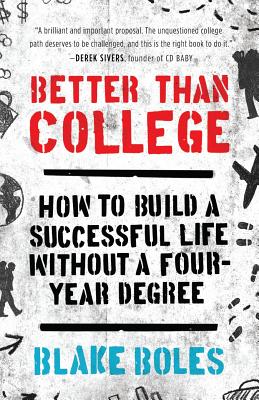
Review of Better Than College: How to Build a Successful Life Without a Four-Year Degree.

I haven't written a book review on this blog for ages. Probably because I've read very few non-fiction books in the last couple of years! But sparked by some newly discovered energy and motivation, I decided to change that, which is why I put aside some time over a couple of days to read Blake Boles' Better Than College: How to Build a Successful Life Without a Four-Year Degree.

The first thing I liked about it was that I could easily read it over a couple of evenings, with plenty of time left over. I'm a fast reader, but even so, this book isn't long. It's concise and straight-forward, which is really nice, as longer, more verbose books on education often just aren't that easy to get through. If you want to appeal to a larger audience, make it something that isn't intimidating to pick up. On a similar note, get rid of any ideas you have about self-published books being sloppy or unprofessional. Thanks, I'm sure, to a lot of work by multiple people, this book looks really appealing. You want to pick it up.

But all that isn't nearly as important as the contents. So, on to that!

There are some things I really liked about this book. I like that it starts with some "propositions" on which the rest of the book is based on, outlining the reasons college might not be as great as it's cracked up to be, and why skipping college might be a good idea. I was happy to see that the idea of it being a "gamble" skipping college was addressed, with Blake pointing out that going to college is just as much of a gamble. Also, of course, some criticism of the cost of college. As Blake writes
This is the real culture of fear that should surround college: not that purposefully skipping college will ruin your life, but that mindlessly attending college (or graduate school) may lock you into a huge pile of debt from which you can never escape.
As I've struggled with figuring out what I'm doing and how to go about doing it, one of the things that never ceases to make me feel better is just going well, at least I'm not in debt.

I also appreciated the big focus in this book on the importance of self-knowledge. To me that's always been an important aspect of unschooling. Knowing yourself, and working to understand more about the way you best function, what's important to you, your strengths and weaknesses, is invaluable. I agree with Blake that that's an important thing to be striving for, whether you're in college or not.

The other main thing I appreciated about Better Than College was that Blake does a very good job of taking the concept and giving you concrete ideas on how to actually implement the whole living-without-college-and-learning-lots-of-stuff-and-becoming-financially-more-secure thing in your own life. Parts were inspiring to me, as Blake makes it seem, if not easy, than at least very doable.

The parts that weren't as strong to me were those talking more about famous successful college drop-outs, quoting The Education of Millionaires frequently, and Blake's list of inspiring people. Made up in large part of financiers, venture capitalists, business writers, and CEO's, they're not exactly the type of people I'd personally look up to. Steve Jobs and Penelope Trunk (author of this charming piece on why women should just put up with sexual harrassment) are not my idea of good role models. With a quote from each "inspiring" person included, one especially stood out to me. William Deresiewicz has this to say:
You can live comfortably in the United States as a schoolteacher, or a community organizer, or a civil rights lawyer, or an artist--that is, by any reasonable definition of comfort. You have to live in an ordinary house instead of an apartment in Manhatten or or a mansion in L.A.... [B]ut what are such losses when set against the opportunity to do work you believe in, work you're suited for, work you love, every day of your life?
My first thought was just really? You can live comfortably as a community organizer or artist? I must just know the wrong organizers and artists... I agree that these are deeply worthwhile vocations, and that you should be able to live comfortably doing such a job. But currently, it can be pretty darn hard to.

This is a good example to me of the obliviousness that seems to run through this book. It seems to have been written mostly for a very privileged audience, and it would have been nice if it was acknowledged that all the suggestions on networking and marketing yourself and similarly hacking your education are likely to work best if you're white, male, affluent (or at the very least middle class), straight, and are generally the stereotype of the entrepreneurial, tech heavy, young professional crowd.

There's a great exercise nearer the beginning of the book, designed to get you to look critically at what's most important to you, and how you can use your skills to help others. I loved it, and the sentiments behind it! But then for much of the rest of the book, everything is couched as a way to gain value or "get" something: get a job, get money, get skills, get ahead. Everything was about networking and badgering people to hire you (and I'm sitting there thinking what about sufferers from anxiety, especially social anxiety?), and seeming to encourage you to look at every single interaction as a networking opportunity. What about simple kindness? Friendships where you're not trying to get anything from the other person other than reciprocal caring?

I ended up liking the first half of this book, with more of a focus on self-knowledge and concrete ways to learn outside of college, better than the second half.

So, I would recommend Better Than College, but with some caveats. I think it addresses some things very well and provides some good tools and ideas, but falls short in other ways.

I hope to continue reading more non-fiction, and have some more interesting books to share soon!

Sunday, February 16, 2014

Natural Born Learners: Unschooling and Autonomy in Education

It's been long in the works, and I've waited eagerly for this book to be released since I first heard about it! Edited by Beatrice Ekoko and Carlo Ricci, it includes transcribed interviews with some of the best known names in the unschooling and alternative education communities: Wendy Priesnitz, Pat Farenga, John Taylor Gatto, Grace Llewellyn, Sandra Dodd, Matt Hern, and many others! And then there's the interviews with grown unschoolers, about half of whom I know or have at least met in person, the other half of whom I know online. So I feel a mix of comfortable and humbled to be included in that company.

The actual interview I did? Well, that I feel less good about. Conducted in April of 2010, to be honest reading it I wince a bit. It's not exactly what I would have said had I been writing those responses now! I was given the opportunity to edit it at some point, but if my hazy memory of the instance serves correctly, I never responded to that email... Oops.

But, my personal opinion on old writing of mine aside, this book looks fantastic. A PDF version is sitting around in my computer, and I am very much hoping to finish and review it at some point, but since that doesn't seem to be happening as quickly as I'd originally hoped, I just wanted to share this book now!

I highly recommend you check this book it out, as all you really need to do is read the contents to know it's packed with insights from many thoughtful and engaging people with important things to say! Read all about the book here, or just go straight to Amazon to buy either the print or kindle version.

Monday, January 30, 2012

5 Ways to Help Someone LOVE Reading

I've written about some ways to encourage a hatred of reading, but now I'm moving on to something different: ways to help someone LOVE reading! This is something that's close to my heart, as despite being a "late reader" (or perhaps because of it, as there's never been anything negative in my life associated with reading), I am a very avid one, and have been since first I cracked open a novel to read myself. So how did this happen? What things in my life (and things I've seen in others lives) have contributed to this deep love I have for the written word? Here are a few of the ways I think can help foster a love of reading...

My father loves reading, too.

1. Read aloud. Some of my fondest childhood memories are of my mother and sister and I curled up together with a good book. Long before I was was reading myself, and apparently even before I was born, my mother would read aloud. Thus, long before I could read myself, I loved listening to others do so. If you don't take much joy in reading aloud yourself, audio books are another great way to listen to the written word, either alone or together with your kids (or your parents!). They were a big favorite especially on road trips!

2. Go to the library. A lot. Ah, the library. Growing up, we'd make weekly trips there, spending hours between the isles, flipping through countless books and piling those we decided we wanted to bring home onto a table we'd claimed as our own (a table placed there for studying, but to us is seemed far more useful as a surface to cover with stacks of books). I remember how excited my sister was when she turned five and could get her own library card! She'd regularly max it out at 50 books, way more than her petite self could manage, leaving her mother and older sister to wobble out the doors with rows of bags filled with heavy books on their shoulders.

3. Talk about books and stories. Being able to share something with others almost always adds enjoyment to whatever it is you're doing, and reading is no different. I remember my mother commenting on multiple occasions that she didn't really get he point of requiring book reports, since she heard verbally all about whatever books me or my sister were reading! And we still do that: tell each other about the stories we're currently involved in, talk about characters and where the plot might be going and things we like or don't like about the writing style. Talking about books and stories is fun.

4. Build a home library I counted bookcases in our house once, and lost count in our very cluttered basement after number 16 (seriously, I'm not kidding). Science-fiction novels share shelf space with cookbooks, tarot reading manuals, books on the history of locomotives, horse breeds, and a huge variety of other subjects. I'm lucky to have grown up in a house were my parents had already been collecting books for years, and to have been a part of continuing that collection through going to new and used book stores, garage and library sales, asking for books for various holidays, etc. Not everyone has the space or money for as large a home library as we do (I'm not sure we have the space, either, to be honest, but we fit them in anyway), and regularly going to the library can serve almost as well. But having a home library, collecting books on various subjects, can create such a wonderful environment for reading.

5. Surround yourself/your kids with a variety of books. Check out a new section at the library, pick up a book at the neighbors yard-sale on a subject or in a genre that you've never read before. Bring home books you think your children might be interested in. Books lying around about all different things are exciting, and can be a wonderful introduction to new things, new worlds, new ideas.

These are just a few (very much overlapping) things that I truly believe can contribute to a love of reading. However, seeing as people are ultimately individuals with different passions, interests, and ways they enjoy spending their time, some people will grow up with all of these encouraging-a-love-of-books-things in their lives and just not be very into reading, while others will have none of this yet become voracious readers. 

I'm sure I missed some good ones in my list, so please, comment! What are some other ways to help someone love reading?

Tuesday, January 10, 2012

5 Ways to Help Someone HATE Reading

I've often heard complaints and worries, from a wide variety of people, about how many people, especially youth, don't like to read.  Blame is placed on a variety of things, from texting on cell phones to uninvolved parents to class sizes in school.  But rarely is the actual way reading is taught and approached and looked at brought into question the way I think it needs to be.

I positively love reading, and have since I learned to read at 8 or 9 (and before that I loved being read to), so perhaps I'm not the best person to be writing this.  Maybe someone who actually hates reading should be writing this, instead.  But then again, people who hate reading often hate writing as well, so would probably have no interest at all in writing about why they hate reading!  Besides, I know all the things that I think  were done right to foster my own love of reading, so I figure I can just think of all the opposite things that could have been done, instead.

1. Regulated reading.  When it comes to things to read, there's an overwhelming variety.  Comic books and magazines and poetry, novels and non-fiction books and instruction manuals and textbooks.  Yet usually the only types considered Important are actual books, not magazines or video game manuals, and within the category of books there are ones considered far more respectable and important than others (for instance, fantasy novels and non-fiction books on fashion are not generally considered important to include in A Comprehensive Curriculum).  There's so much out there to read that it's virtually guaranteed everyone can find something they enjoy reading.  Yet if someone is required to read only a certain type of book, only the type of reading deemed most "educational" and "worthwhile" the one doing the requiring is infringing on whatever relationship the learner could find themselves with the written word.  Coercion breeds resentment, and deciding what someone else should be reading will likely just create resentment against both the enforcer of that should and against reading itself.

2. Required reading.  Similarly to the above, requiring people to read certain amounts or at certain times of the day or for certain reasons is a great way to make reading feel more like work.  If something can feel fun instead, that's always what people should be aiming for!  As with any forced teaching or forced "educational activities," making reading mandatory doesn't make it something fun, it makes it something to resent.

3. Book reports.  So often growing up I heard homeschoolers discussing the book reports they required their children to write upon completing any book they read.  A forced book report (something often a very unappealing thing to write even for people who usually enjoy writing) looming at the end of every completed book, is not a very good incentive to do more reading.  If you want people to like reading, it has to be something positive and enjoyable, and anything that's done to make it feel more like work is really not conducive to people learning to enjoy reading for it's own sake.  When people are most likely to not mind doing things that feel like work is when that work is freely chosen, and when it feels meaningful and important.  Book reports?  Don't necessarily feel very meaningful!  Critically discussing books can be (almost) as interesting and enjoyable as reading itself, but that discussion can happen verbally or in many different written forms (discussion groups and chat-boards, blog posts, Amazon reviews, essays, or yes, book reports) and is of course only enjoyable when the reader has freely chosen to do so.  It's also important to remember that it doesn't signify a lack of comprehension if someone is happy reading without doing any type of break-down or discussion afterwards.  Different people learn and process things in different ways, and deciding everyone is best served by writing book reports is just going to, once again, breed resentment and negativity towards reading.

4. Shaming reading choices.  Maybe a parent doesn't actually regulate as such what their children read, but exclaims upon seeing that horror novel or Superman comic in their children's hands "you're reading that??," with a healthy helping of disdain.  This can be a very passive-aggressive tactic, or it can just be a knee-jerk comment made without thought, but either way, it's not pleasant.  People want approval and support from those they share their lives with, from the smallest choices and quirks to the biggest life decisions and goals, and even those smallest comments can be hurtful.  If reading is something they have to anxiously wonder what their parents will think and say about it, it's not going to be nearly as much fun (not to mention how harmful that type of interaction is to the relationship between parent and child!).

5. Focusing on reading skill.  I say this as opposed to focusing on reading enjoyment.  Reading skills are certainly important, and certainly influence reading enjoyment (if the act of reading itself is a struggle due to learning dissability or some other reason, it's obviously not going to be very enjoyable and needs to become less of a struggle first). But when you're purely talking about reading enjoyment, as I am in this post, I'm going to say that as long as someone is able to basically read without extreme difficulty, I think it's really important not to focus on individual reading skills, and instead on enjoyment. If someone is being tested regularly, prompted to read faster, asked regularly to read aloud (as a test of ability, not for fun, since reading aloud together can be really fun, no matter what age people are!), or otherwise has a parent focus strongly on reading skills, they're turning reading into something to feel anxious and possibly inadequate about. If someone enjoys reading, that's what's important.  And if someone enjoys reading and wants to do more of it, improved skill in the activity will naturally follow!

Of course, some people will face some or all of the things on this list, and still come out as passionate and voracious readers.  This list is simply some things I think are a lot more likely to harm than help!

How is your relationship with reading?  Do you think I missed anything that should be on this list?  Chime in in the comments section and share your thoughts and experiences!

Saturday, October 22, 2011

Review of A Rule is to Break: A Child's Guide to Anarchy

I received this book from the author and illustrator free of charge, but I am not receiving any other type of compensation for writing this review.

It's always exciting getting books in the mail. I always eagerly rip through the packaging, quickly finding a comfy (or less-than-comfy if I'm in a particular rush) place to settle down to rifle through the pages if it's a longer book, and simply read straight through if it's a shorter one.

A Rule is to Break: A Child's Guide to Anarchy by John Seven and Jana Christy Seven, being a picture book, I read reasonably quickly, though I did take a bit of time on each page to fully admire the wonderfully charming artwork.  I've long admired Jana's art, how gorgeous and organic it feels, the colours and textures and style... It's just lovely!  And this book was no different.

Well, not when it comes to the good artwork, anyway.  In other ways, it is VERY different from any other children's book I've read! 

Many (I think it's fair to say most) children's picture books are thinly disguised morality tales, and when not outright morality tales, are still strongly pushing and presenting the norms and expectations of the dominant culture.  Not particularly surprising, really, considering that the writers of most children's books, like most people, are very firmly enmeshed in the dominant culture. And really, doesn't everyone know that children should listen to their parents and teachers, follow all the rules, behave "well," etc.?

John and Jana, unschooling parents themselves, present a very different view in A Rule is to Break, saying on their site "children are natural masters of anarchy, but are too often unaware of the power they wield in their cute little hands, and too seldom encouraged by grown-ups to figure that out!  In A Rule Is To Break: A Child’s Guide To Anarchy that determined little devil girl Wild Child wages her own one-girl rebellion against the stifling world of adults who just want her to behave! And she brings her friends along!"

With advice from "ignore school and read books! Use your brain." and "forget about grocery stores and get dirty in your garden!" to sillier but no less engaging pages urging you to "hug the ugliest monster you can find!" this book is definitely not your run of the mill children's book.  And I love that!  Because what this book really feels like is that it's simply celebrating childhood: the joy, the wonder of discovery, the spontaneity and strong emotions (one page reads "go ahead and get stompy!" with an obviously angry/frustrated Wild Child expressing her emotions in the form of stomping). 

I also appreciate that though identified as a girl by the authors, there's nothing in either the Wild Child's dress or behaviour that conforms to any gender expectations. She's just a kid who likes doing things her own way!

So there you have it.  If you hadn't already gotten that impression, I definitely recommend this book.  I've been bringing it with me on the various trips I've been on in the late summer/early fall, to show to anyone I think might be interested, and have been getting LOTS of positive responses to it!  So if you want to buy it, you can find out how to do so here, OR you can download it for free here!

I hope that you, and any children in your life, appreciate this book as much as I did.