Showing posts with label uncollege. Show all posts

Monday, September 14, 2015

Unexceptionally Exceptional: A Gateway to Learning

This is the third and final installment of Unexceptionally Exceptional, which is the text from the talk I presented at the Northeast Unschooling Conference at the end of August. You might want to read part one and part two first: The Meaning of Success, and Time for Struggle, Time for Joy.

Downtime of all sorts can be valuable, and one of the way that manifests is in boredom.

I decided that me and my sister should sing a duet for the talent show because I was bored. I’ve been bored a lot in the past year, mainly because when things aren’t going great, I’m less likely to have a good routine going with regular activities, and more likely to feel restlessness.


So, in some ways the boredom I’ve felt has been a sign of things not going as well as they could be. But in other ways, boredom has always been a force of creativity in my life. As I wrote in a post on the Home School Life Magazine blog back in February:
“Boredom acts as a gateway, as the beginning of something new or different, or the introduction (or reintroduction) to a new hobby or passion, something that will go on to be an important part of our days. 
Or not. As important as the productivity that boredom can lead to, equally important is simply the space of boredom itself. The time for us to get past the initial restlessness or discomfort of not being busy, not doing, and settle into reflection, observation, stillness. We need the time to process and digest our learning, our experiences, and sometimes boredom can be a part of that.”
To struggle, to be bored, is part of the process of learning, and of healing.

I’ve never sung a duet in public before. I sung in a church choir and a homeschool choir when I was young, but my voice, when others are listening to me perform, has always been part of a crowd: a hopefully harmonious small part of the whole. I’ve sung in small groups, casually, where everyone is messing up and messing around, playing instruments they’re less familiar with and maybe trying out a new harmony. It hasn’t felt like much pressure.

But what I was suggesting to my sister when I turned to her and said “we should do a duet at NEUC” was scary. Everyone would be listening to my voice. They’d hear if I messed up.

But, I was bored that evening, and I wanted to sing with my sister, and once the thought crossed my mind and the words left my mouth, I became determined to follow through with it.

We sung Safe and Sound by Taylor Swift and the Civil Wars.

Sometimes, too, boredom is the impetus to actually work through emotional shit. Keeping busy, always talking and working and doing, can be a way to hide from difficult emotions, to avoid facing difficult experiences. Boredom, an absence of busy-ness, has forced me to process what’s been happening in my life, to reflect, accept, and work towards moving forward.

And as I move forward, I find myself asking again and again, what is success? It’s layered and multi-faceted, and my definition is constantly changing. I’m working on being at peace with my life, with where I am right now.

I’m learning to move forward. I may still be grieving the loss of two cats who meant the world to me, yet I have two different cats who have now come to mean an incredible amount to me as well. I’m still not living the dream life, there are still so many things I might want to change. Yet the garden still grows, and my family still loves me.

My darling Bea, of the no-tail and too-many-toes.

Success isn’t something you can attain in one grand swoop. I’m reminded of an Allie Brosh comic, where the author in scratchy comic form is shown gesturing sweepingly towards a purple ribbon wrapped trophy on the mantlepiece. “That right there is my ability to be responsible” she says. “I won it when I was 25.”

People my age, whether unschooled or not, have so many flawed and conflicting beliefs about what it means to be a successful adult, and how that can achieved. I guess we’re all floundering, at least some of the time, and just trying to figure out what we’re doing.

Unschooling, too, is a practice of learning and un-learning and re-learning, trying to find a path to respectful relationships, a peaceful home, and joyful learning.

Ah, the joy. Because the thing is, no matter how hard some times in our lives might be, no matter that our lives might not always look how we think they’re supposed to, there’s so much joy.

Pursuing an unschooling life is pursuing joy. It’s cultivating the excitement of discovery; the satisfaction of doing hard things on your own initiative; the companionship of strong relationships and time spent with people you not only love, but like.

Me and my mommy.

I spend as much time as I do talking and writing about unschooling because, despite none of this being new to me, it still fills me with so much excitement. My mind spirals into thoughts of what I’ve learned, with great pleasure, to do: bake pies and ferment kombucha and grow zucchinis. I think of all there is that I’m going to get to learn in the future. I think about how learning feels: the playful, relaxed, yet deeply focused intent of doing something I truly love, something that hits the perfect sweet spot of challenging yet attainable. It feels like freedom. And it’s one of the best feelings there is.

How can I not consider that joy, in and of itself, a form of success? I delight in learning, and in sharing, and in making the tenets of unschooling a continuing part of my adult life.

This past year may have tested me in a hundred different ways, but I’m proud that I managed, through everything, to find those joyful moments.

It takes a shift in focus to start seeing the success in your own life. It’s hard. Do I ever know how hard it is! I struggle every day to truly value my unique education, to recognize how much I’ve done and am doing in my life. To really feel my success.

But whenever I force myself to stop and really look, I can see it. I see the learning, and the growth, and the joy, and I know that I’ll be okay. I’ve got this. I’m busy building the life I want one messy, difficult, enthusiastic piece at a time.

Thursday, September 10, 2015

Unexceptionally Exceptional: Time for Struggle, Time for Joy

This is part two of my talk Unexceptionally Exceptionally, which I presented at the Northeast Unschooling Conference a couple of weeks ago. I'd suggest reading part one, The Meaning of Success, first! Look for part three on Monday.

As much as I might often be seen as “successful” by unschoolers, this past year has not been one which looked very good from the outside, and one that often didn’t feel very good on the inside. This past year in my life has been rough. When I was writing the outline for this talk, I put down “the year of hell” as the heading for this section. For any Star Trek Voyager fans in the audience, you’ll remember the episode of that title, where in an alternate timeline, everything just keeps going wrong: aliens keep attacking; equipment breaks; people keep dying.

My own year of hell has been a time of great difficulty for my whole family. In December, a beloved cat who had been with my family for almost 14 years passed away unexpectedly. In January, my great aunt died. In february, my grandmother’s basement flooded, and shortly afterwards, she fell down the stairs, hitting her head on rough cement uncovered by flood repair work and getting a concussion. In March our other elderly cat, who had been with us just as long and been just as loved, got sick and died shortly after. In April, my father had surgery.


When I see people criticizing unschooling for its supposed sheltering of children from hard things, I laugh. My response to that concern, whenever it’s expressed to me, is that the world provides plenty of difficulty all on its own: no need for parents to artificially engineer misery in the lives of their children.

There’s a quote I really like by Alfie Kohn, who says:
“People don’t get better at coping with unhappiness because they were deliberately made unhappy when they were young. On the contrary, what best prepares children to deal with the challenges of the real world is to experience success and joy, to feel supported and respected, to receive loving guidance and unconditional care and the chance to have some say about what happens to them.”
I guess my parents did something right, because I seem to have ended up as an adult who can cope with adversity. This past year success has felt like being there for my mother when her aunt passed away. It’s meant rushing out of the house in record time to meet my grandmother at the hospital, and bringing my father in for his surgery along with my sister, hiding the terror we were both feeling so we could joke with him while he waited. Success meant bringing my cat’s body to the veterinarian's office to be cremated, even though I wanted to just curl up at home and grieve, because she was my cat and it was my responsibility.

Sometimes success means simply doing what you need to do.

And, through it all, learning keeps happening. Not even in a growing from adversity way, though that can’t help but be part of it, but just through everyday exploration. Books are still read, questions Googled, words written, Ninjutsu classes attended, skills honed and projects completed.

A large part of unschooling is seeking joy in learning: embracing learning as a playful, exciting process. But it seems that in all our discussion of that joy, some people seem to take to heart that that’s all unschooling should and can be. I see people concerned that their house isn’t constantly filled with light, or that life sometimes gets in the way of living in a way that looks how they think unschooling is supposed to look.

I think that cooperation and exploration and yes, joy, should always be the goal: of course we all want that. But there needs to be the recognition that circumstances will sometimes intervene in surprising and on occasion devastating ways, and what happens through that might not looks like the ideal of unschooling, but it will be real, and genuine, and the learning will still be happening, every step of the way.

My year of hell has included a whole lot of time spent not in crisis, but simply in living.

“When life is busy testing your endurance, it seems like the perfect time to bring a bit more magic into your days.”

I wrote that line back in January, and that thought, that idea has come to mean a lot to me in the past year. More than any other time in my life, I’ve been reminded over and over again of the importance of finding joy each day, in all it’s forms and in any way you can. Bringing little pieces of magic, of inspiration, into even the most difficult of days.

For one thing, I could spend hours picking berries. The only thing that generally drives me back indoors is when I’ve found every last ripe one in whatever patch of brambles I’m delicately working my way through. Sometimes I hum to myself. More often I’m silent, moving slowly, listening to the soft rustle of branches, hum of insects, and birdsong. Even the thorns on my favourite black raspberries seem more like a challenge than an inconvenience.

Black raspberries.

A lot of what bringing inspiration into my life has meant is self care rituals: picking berries; making myself and anyone else who’s around a fancy coffee; making a beautiful plate of food; cutting flowers from our yard and putting a bouquet on the table; baking a loaf of bread… Much of my self care involves food, because that’s what’s important to me, but everyone will have things that make them feel grounded and nourished.

And a lot of what “magic” has meant to me has been learning. I haven’t taken any classes since last fall: nothing has been formal, and little has been with other people. Even turned inwards, as I’ve been, towards family and healing, I’ve found myself still learning constantly, in countless simple ways.

Gardening has been a big thing for me and my sister this Spring and Summer. My sister Emilie has spearheaded things, at times dragging me along, short on motivation, behind her. Conversations on car rides have been about the ideal soil composition for beans versus tomatoes, and how best to treat powdery mildew on zucchinis. There have been sweaty days spent building a large trellis out of branches and reclaimed posts for our winter squash, building raised beds, and transplanting small growing things. In more recent days, time spent in the garden has waned, as more and more that’s left to do is simply harvest, take stock of what we did wrong and right, and discuss how we want to do things next year.

The tomatoes did especially well this year.

Besides the garden, bringing two new cats into our home, in a desperate attempt to fill the holes left by our recently deceased furry family members, has lead to plenty of breed research and new discoveries about cat behaviour, as each new animal always presents new challenges and new joys both. I canned some jelly semi-successfully for the first time this summer--the canning part was successful, though the “jelly” was more syrup than anything else. I’ve learned more about areas of history I previously knew little about; I’ve learned to cook new foods; I’ve learned that I can step up when needed even when I’m personally struggling.

A whole host of learning, from how to handle an overstimulated kitten and how to create an ingenious tomato watering system, to deep personal growth.

Remaining aware of all the learning that keeps happening, no matter what, can be encouraging and soothing. When it feels like you’re “doing nothing,” it might be a good idea to pay more attention to all the things that you, and your family, ARE doing.

We live in a culture obsessed with productivity. Whether you want to blame it on capitalism or on the puritanical work ethic, the fact remains that busy-ness, doing something, is generally considered good, and not doing anything “productive” is seen as laziness, as wasted time.

The idea that time can even be wasted, that every moment should somehow be accounted for seems like a deeply toxic idea. It’s definitely proved a harmful one in my own life. I’ve struggled with mental illness for years, and this year has been a particularly trying one with all that’s happened, and I struggle with the idea that I’ve “wasted” so much time in struggle.

In a culture that sees a lack of productivity as one of the seven deadly sins, people who are struggling are often seen as lazy. They just need to get over it, and pull themselves up by their bootstraps.

The reality is that big life struggles are sometimes inevitable, and there isn’t an exact recipe for how people are “supposed” to deal with adversity. Sometimes you just need time and space to heal, and to get back on your feet.

Our two new black cats, Silver and Bea.

Both children and adults need time to struggle with those big life events, to make sense of them.

One of the core tenets of unschooling is recognizing that everyone has their own timeline when it comes to learning. The same is true of emotional difficulties and growth. When we take constant productiveness as a measure of success, we’re doing a great disservice to ourselves and the people around us. Time is a great gift: time to figure things out, to grow, to process, to hibernate. Periods of downtime are essential, especially when life has been extra hard.

Part of learning to be kind to myself is learning not to beat myself up over a lack of productivity, not to punish myself for struggling. Sometimes picking a full container of raspberries is success enough.
As a grown unschooler, I might feel the pressure to excel in obvious ways especially keenly, but recognizing that the only timeline I’m on is my own allows me that space to breath, and when I’m kinder to myself, I’m more able to do and learn and grow.

Wednesday, May 13, 2015

I Don't Want to Build My Own Curriculum, I just Want to Live My Own Life

I read a lot of posts by young adults who skipped college in favour of self-directed learning, from both unschooling and traditionally schooled backgrounds. It’s pretty exciting for me to see people discovering unschooling at all different ages, and I love that so many young adults are embracing it! I love to read about the discoveries and experiences of fellow happily unschooling 20-somethings. But I find myself noticing lately how often “uncollegers” talk about the process of their learning, the detailed plans and self constructed curriculum, and I’m struck by how very different my outlook is. It gets me thinking about the positives--and the negatives--in my own learning, and how it compares to others’ experiences.


In some ways, I wonder if my own less structured approach is a sign of how long I’ve been unschooling, and how much deschooling I’ve done. Many seem to feel a strong pressure to create something school-like, something to point to and say “look, I’m learning, just like if I was in college!” This is a pressure which, while I sometimes feel it, it doesn’t really affect my learning. I’ve been an unschooler for so long that I’m very aware of how ever-present learning is, so I notice and appreciate how much I’m learning and growing without needing to justify the validity of my education, at least to myself.

On the other hand, I think a little more planning would do me good, and maybe a little more thinking about my learning. I’d like to have a posting schedule on my blog, and manage to convince myself that self imposed deadlines are still “real.” I’d like to get better at saving and organizing all the articles I read on a variety of subjects every day. I’d like to get better at networking with like-minded people in my local communities.

But when I start questioning whether I’ve been approaching my college free life learning in the best way, the conclusion I find myself coming to is that far more important than building your own curriculum, or getting caught up in all the details of your “education,” is understanding what you want from your life. Knowing your strengths, your weaknesses, your values, and what type of person you want to be. If you know the answers to those questions, from that base the paths to follow and the steps to take start to become a lot clearer.

I know that I’m good at communicating, and feel that that’s a big asset in my life. I’m not so good at consistently putting myself out there in the “real world,” networking, making friends, and getting involved in exciting projects. I find learning in front of other people scary, so I know that taking classes can be a really good way to stretch myself and overcome that fear. I write most prolifically when under the pressure of an imminent deadline, so I know that deadlines provide a certain helpful structure and much needed push when it comes to growing my writing career. I know that I pretty much always regret not trusting my gut, or making sure a situation or opportunity is in line with my values and with who I want to be as a person.

Yes, I need to get better at being organized, at being reliable, at producing even close to as much writing as I want to be doing. I’m working on it, struggling sometimes, finding moments of clarity other times. But whenever I start to flounder, detailed planning never seems to help much. Instead, going back to that base, those important questions, taking a deep breath, and setting a few attainable goals seems to be the best course of action so far. Different ways of learning work for different people, and I know for some, the excitement is in the details and organization. Just not for me.

I’m still figuring out what I want to learn and do day by day, and I think to some extent I always will be. As we all know, learning isn’t finite: it’s a lifelong journey, an endless series of experiences and choices.

My education outside of college isn’t perfect. My life is not exactly what I might want it to be right now. But it’s mine. It’s my choices, my experiences, my values and goals. And it’s something I value deeply. I’m not building a curriculum. Instead, I’m just busy figuring out what it means to live a good life.

Wednesday, November 5, 2014

Valuing a Different Kind of Education

This piece was written back in July, for a writing project that ended up being shelved for the time being. So, I thought I'd share it here instead! A look at how I value (or don't value) the uniqueness of my education.


I had an epiphany about my own relationship to my learning and education recently. This came about after a couple of different minor events.

First, I had a lovely exchange with a reader. They referred to me as a “successful young professional,” and continued to say that “I guess my definition of success (at least what I had in mind when I was writing to you) is that it is based on the connections you've made with the fellow people in your field, the ideas you offer to your field, and your mastery of the subject. Your blog has allowed you to make those connections and get those ideas out there. And considering that you've been unschooling for more than awhile, I assume you are, at the very least, on your way to mastery.” I was taken aback, never having been referred to as a “professional” before, and flattered that someone thought I seemed so successful.

Secondly, after my parents had spent the day with some old friends they hadn’t seen in a while, I nervously asked what they’d said about me and my recent pursuits. How did they make me sound? I wondered did I come across as successful, or a real loser?

The next day, in the car with both parents, I got in a conversation about school and work. I said that I couldn’t see myself taking courses in non-fiction writing through a university, because I felt for the most part they were teaching a style of writing and communication that is somewhat outdated, as I don’t think most universities (and the professors who teach at them) have fully embraced the changes that the internet and blogging has brought. I also talked about how outdated traditional CV’s and resumes are becoming, as increasingly what’s important is building some type of online portfolio, especially when showcasing any type of work that you can fairly easily do without any type of degree or diploma. Experiences are now starting to matter more than degrees, I said.

Later that day, the epiphany came. I thought, wait a second, I say all this, but I don’t actually believe it when it comes to myself. Over the last couple of years, I’ve become expert at making myself sound as traditionally successful as possible. “I worked catering last year,” I say. “I’m considering going to culinary school.” I tell people “I was homeschooled,” and try to assure them that I turned out perfectly fine.

I’ve become invested in making myself seem as normal as possible.

I didn’t set out to do that, and in part I ended up doing so just out of a desire for privacy. Why should I expose my life and choices to the judgement of near strangers? I thought. 
"Normal" sisters? I don't know about normal,
but I think we're pretty cute regardless!

That’s not the only reason, though. There’s a part of me that feels ashamed of my background. Ashamed of what I haven’t done. Namely that I haven’t worked in a “normal” job, ever, or ever been financially independent. Ashamed that, at 23, I don’t have more to show for myself.

This has lead to a series of attempts to at least try and look successful, even if I don’t feel like I’m actually that successful.

I suppose this says something about how deeply embedded these cultural messages are, that someone with my background in education, who regularly talks about how great self-directed learning, unschooling, and skipping college is, can so blithely fall into a trap of judging my own success by such rigid standards.

Not only is this bad for my self-esteem, it’s also bad for my success. If I really believe in everything I say, which intellectually I do, then I need to actually start acting like it.

I have been successful in many ways. I’ve built an extensive online portfolio, in the form of archived blog posts and a personal website chronicling various pursuits and experience. I’ve had my work published in various alternative education magazines, journals, and even a book, and have spoken at several conferences. I’ve turned down some media interviews and accepted others, and I’ve had many people express that my work has impacted their lives in a meaningful way. I’ve met and talked to people doing similar work whom I admire and who provide inspiration to me.

All this is to say that I’ve created a body of work that is appreciated by lots of people in specific alternative education circles, all while feeling really positive and excited about the work I was doing.

In Blake Boles’ book College Without High School, one of the suggested Zero Tuition College “assignments” is to “become a public intellectual.” Expanding on what that entails, he writes: “public intellectuals research, think, talk, and write about a social problem but don’t necessarily hold formal credentials. They spread their messages via blogs, websites, books, magazines, podcasts, videos, and other media platforms.” I told my sister, Emilie, “apparently I’m a public intellectual.” she laughed. “That sounds amazingly pretentious,” she added.

It does sound more than a little pretentious, it’s true. But it’s the first time I’ve seen essentially what I’ve been spending the usual university years doing laid out as a desirable and worthwhile alternative to college or university.

It’s also yet another reminder, among the many that lead to my aforementioned epiphany, that what I’ve done in my life, so far, is not just important and meaningful, but “marketable.”

When I strive so hard to make myself seem more normal, my choices more conventional, and my experiences more in line with my traditionally schooled age-peers, I lose out on an opportunity to not just sound more impressive, but share the genuinely cool accomplishments I’ve made and experiences I’ve had.

My unique background is an asset, not a weakness. A reason people might find me interesting to talk to at the least, or offer me amazing opportunities at the most. The reputation and body of work I’ve built for myself can continue to be both meaningful and challenging, as well as leading to money making opportunities (either through opportunities I create myself, or through a potential employer wanting to hire me based on my experience).

Perhaps all this should have been obvious. Bits and pieces have been, at different times. I’ve been proud of some work, greatly valued some experiences, knew that some of what I had done was important to others.

But I didn’t really value the unconventionality of my lack-of-college experience, or appreciate just how much I’ve gained by doing things differently.

After having the thought that I was ashamed by what I hadn’t done over the last few years, I was quickly flooded by excitement at the idea that I could speak with pride about what I had done.

Such a simple yet profound shift, to go from “look at all I haven’t done” to “look at everything I have done.”

Whether you’re a teen or grown unschooler, an unschooling parent, or a young adult who’s chosen to forego college or university, I think it’s important that we cultivate just such a mindset. It’s so easy to get caught up in comparing ourselves to those who are doing things more traditionally, but we do a great disservice to ourselves when we do that. In focusing instead on the value in the true uniqueness of our experiences and education, we can instead be proud of what we’ve done and how we’ve chosen to “get an education” in our lives so far. Feeling confident in the skills we’ve gained and things we’ve done outside of school seems important to me primarily because of how much better it is for my emotional well being. But it’s certainly also of great benefit being able to share that confidence with others. If you’re secure in the worth of your unique experiences, work, and skills, you’re going to be better able to present yourself and your accomplishments to the important people in your life, and better able to turn your skills into ways to earn money, make important connections with people doing work you admire, and build a life that feels truly successful to you.

Tuesday, October 28, 2014

The Role of Boredom and Dabbling in Pursuit of Passionate Learning

One of the greatest benefits of unschooling, it's frequently said, is that it gives children the time and encouragement to truly find and embrace their passions. I agree with this, for sure, yet I've noticed that many people new to unschooling or self directed learning, whether they're parents or young adults newly risen out of college, panic when they don't see a passion immediately manifesting itself in their life or the lives of their children. We're supposed to be driven by passion and digging deep into real learning, they think, so what's with all this boredom and flitting from one thing to another?

I'd say that both of those things, instead of being signs of failure, are just part of the process.

Deschooling
"For me, it was probably about a year before I felt like we were truly unschooling, not deschooling. There was no announcement, no graduation ceremony, but one day I realized I no longer felt like I was emulating the lifestyle—we were living it. I was no longer trying to wrap my mind around the principles, instead I was spending my time supporting how those principles were playing out in my unique family." Pam Laricchia, Why Deschooling?
If you're new to life learning, I think the first thing to realize is that it's going to take time. Time to adjust, to move past school ideas about what learning looks like, time to figure out how your new learning path is going to work in your own life. I feel like people tend to rush things, or feel like the change is going to be immediate, when in reality we're all taking things step by step, no matter where we are in our life learning journey. As I regularly tell myself in a variety of circumstances, slow down, breathe, and try not to panic if things don't look the way you'd imagined right off!

Boredom
"What if, I wondered, as I enjoyed the sights and smells of the early morning, more people paid attention to the journey of life, not just the destination? What if they paid more attention to their experiences moment by moment? I suspect they would find that boredom is, as F. Scott Fitzgerald wrote, a filter through which emotions, experiences and, yes, solitude can pass, resulting in a soaring of creativity and imagination." Wendy Priesnitz, The Benefits of Boredom
"Out of boredom, interests spring like mushrooms in moist soil. In the autonomous zone we have created, students have the time and support to explore each of these interests as fully as they choose. If that interest pays dividends, if it engages the student in a compelling way, sufficiently meeting her intellectual, emotional, kinesthetic, or other needs, she will stay with it, dig deeper, until she achieves what feels like mastery to her. Then she can apply those lessons of perseverance, effort, and excellence to any other topic, well into adulthood. If it does not meet these needs, if its hooks do not catch, she will let it go and return to the difficult but rich soil of boredom, until the next mushroom appears." Michelle Loucas, Bored? Explore It!
“Rest is not idleness, and to lie sometimes on the grass under the trees on a summer’s day, listening to the murmur of water, or watching the clouds float across the sky, is by no means a waste of time.” Sir John Lubbock, Lord Avebury
Before I sat down to write this post, I frustrated my sister by chattering, singing deliberately off-key, being melodramatic about everything, begging her to let me have coffee, and otherwise being difficult. In short, I was bored, and showing it by being very exuberantly annoying. Complaining is part of my writing process, I recently said on Facebook, and while I wrote it with a smile, I believe it to be true, because boredom is part of my writing process. It's in the restlessness and frustration of a mind that has nothing else interesting to focus on that a post starts to take shape. It's while I'm lying awake in bed, unable to sleep (which must be the ultimate in boredom), that I start to build a narrative for an article I've wanted to write for ages, or start putting together a menu full of interesting new dishes to experiment with.

Without boredom, I wouldn't be able to create, to be creative. I'd say that's true of most if not all of us.

Not only does boredom lead to creativity in the areas we're already proficient in, but it also leads to new discoveries. Whether you're new to unschooling or not, I think boredom is just a part of life, and while boredom that becomes a continuous and ongoing companion might definitely be an indicator that changes that need to be made, in general, boredom is just the space that allows us to discover new things we wouldn't otherwise discover. It's boredom that leads me to pick up a guitar for the first time in many months and try to learn a new song, or read about a new subject online.

Boredom is an essential element in both creativity and discovery, and should be recognized as the restless stage that proceeds a new project, passion, or breakthrough.

Dabbling
"This is not to say that, when the student finally decides to engage in an activity, it will always be immensely satisfying or long lasting. She may flit from activity to activity for quite some time. She may embrace art for weeks, with devotion and drive, only to drop it unceremoniously one day and lapse back into a painful bout of boredom. Or, she might trade in art for kick boxing, a passion that she adopts fiercely and exclusively for a day or a month, only to abandon it as well." Michelle Loucas, Bored? Explore It!
"It might appear that some children are more prone to 'quitting things' and less able to 'commit' to activities and stick with them – but what if you flip that around and view those children as dabblers, experimenters – open to the world and curious about everything? Those are the children who, if their trust is not eroded by parental control, will try anything once (or more than once). And yes, they will quit more things than those children who dive deep and stick around longer with one activity. But that’s due to the sheer volume of things they try! If you have a child who decides she wants to put everything she has into martial arts and music, and then decides later that she actually prefers martial arts and is tired of music for now, she has a fifty percent quit rate. If you have a child who tries sixteen different things in one year, and ends up liking four of them a lot, that child might have a seventy-five percent quit rate, but he now has four activities he loves, not just one." Lyla Wolffenstein, Dabbling, Digging Deep, and Quitting: The Real Costs of Parental Pressure
 I've gotten more than one message from a parent concerned that their child can't settle on anything, each day drawn to a new interest or subject, forever flitting from one thing to another. As the above quotes point out, this "dabbling" is likely either due to the personality of the individual, or is simply part of the process of finding a passion.

One of the things I've always appreciated about unschooling is that I never had to spend more time than I wanted on any specific subject or interest. There were hundreds--thousands--of questions answered by Google or a quick look at a book from our home or community library. Just because something is interesting, doesn't mean that interest has to last longer than it takes to find the answer to a question, and if it doesn't end there, it may take just an hour or a day's exploration to feel satisfied. Because really, that's what you're looking for: satisfaction, or the discovery that something really isn't for you, which is a satisfying sense of closure in itself.

The way you decide if you want to do something is by trying it. And if you look around and feel yourself excited by the vast plethora of options available to you, then you're probably going to try a whole lot of things. Most of them won't stick, won't be as interesting as you thought or will take up more time than you're prepared to commit, or perhaps just won't feel quite right.

That desire to explore, try new things, and take risks is a very childlike attitude, and one that shows strong curiosity and a joy in learning and discovery that too many people lose as they grow into teenage and adult years. Instead of seeing dabbling as a failure to stick with things, it should be valued, and those who practice it should be recognized as the curious individuals they are.

Dabbling, the same as boredom, is an integral part of exploration. For some, this dabbling style of learning will remain lifelong, and for others it will simply be what happens in between periods of more intense focus on a specific activity or topic. Either way, exploring a wider range of topics and activities is certainly a positive thing.

Play
"For a small child, there is no division between playing and learning, between the things he or she does 'just for fun' and things that are 'educational.' The child learns while living and any part of living that is enjoyable is also play." Penelope Leach
"When we treat children’s play as seriously as it deserves, we are helping them feel the joy that’s to be found in the creative spirit. It’s the things we play with and the people who help us play that make a great difference in our lives." Fred Rogers
"The central problem is that we undervalue pleasure. We live in a culture that is consumed with the Protestant work ethic. Work as work, not work as play, is a powerful pressure against play. In that ethos, pleasure for itself is frivolous. So play is not widely seen as a value in itself for adults. I have learned, to the contrary, that play is, in short, excellent for my health — for brain, mind, and emotions, all of which promote well-being in my life, economically, emotionally, and spiritually. For health, everyone should choose and pursue activities that are playful and truly pleasurable." Bernard De Koven, Reshaping The Brain Through Play
This guy brings a lot of playfulness into my life.
Dabbling in learning, that free flowing exploration without a strict timetable or set goals or an authority figure looking over our shoulders, is learning that's playful. Increasingly, play is being recognized for the important role it plays in learning and health, for children especially but also for adults. I recognize that playful, free flowing feeling when I'm reading a funny piece of history aloud to my sister while we both laugh, or when I'm so deeply immersed in a cooking project, simultaneously focused and relaxed, a bright joyfulness burning in me while I fiddle and create. I feel it when I'm playing with my oversize shaggy puppy, both of us focused intently on each others' body language and vocalizations, completely engaged in communicating and playing together.

All of these activities feel deeply engaging for my brain, as well as being undeniably fun. Yet despite the growing recognition that play isn't just helpful, but an essential part of growing and learning for countless species, humans included, it's still often not seen as "real" learning. Educational things are supposed to look like work, not play, and too few people realize that you can be engaged in both at once.

Passionate Learning
“We learn because we want to learn, because it’s important to us, because it’s natural, and because it’s impossible to live in the world and not learn." Peggy Pirro
When my sister Emilie was young, she was fascinated by Egyptian mythology. Sparked by a love of Yu-Gi-Oh, which takes inspiration from that mythology, Emilie spent lots of time reading about and researching the subject. She'd talk about how different gods changed over time and by region, she made a presentation for a homeschool expo, and when touring the Smithsonian Museum of History in Washington DC, she indignantly pointed out that one of the items in the Egyptian exhibit was mis-labelled. A middle-aged man, acting as a tour guide for his companions, and talking about the exhibits in Cairo that he'd seen previously, looked down at this small child in shock, and said "you're right."

Finding passions to focus deeply on will be an integral part of unschooling for almost all of us. I do think it's an immensely positive and important part of learning for people, at least sometimes and with some things. However, I'd stress that I think that it's an important part of learning, not the be all and end all of unschooling. We need to recognize the important roles of boredom and dabbling, of free play and exploration. Some things will turn into passions that stay with us for years, but many other interests will be dropped after the briefest of perusing. Countless hours will be spent in exploration, yet that exploration will likely be precipitated by boredom. It's all learning, it's all part of the process, and it's all important.

When we embrace learning as a lifestyle, and as a lifelong passionate pursuit, we learn to value the whole package, boredom and all. We learn that the restlessness comes with rewards, that no time spent in exploring is ever wasted, that idleness breeds creativity, and that play is essential. I'm still re-learning these things over and over again, despite how little schooling I've had in my life, and I'm being reminded daily of how important it is to take my own advice on learning to heart. But what I'm striving for, always, is to live a life filled with joyful learning, with all its inherent struggles and rewards.

I hope you'll join me in this passionate pursuit.

Monday, June 23, 2014

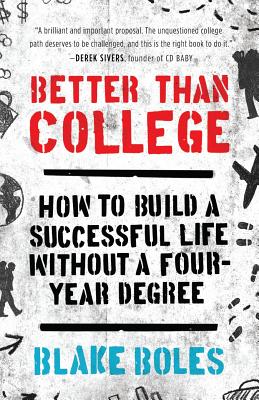
Review of Better Than College: How to Build a Successful Life Without a Four-Year Degree.

I haven't written a book review on this blog for ages. Probably because I've read very few non-fiction books in the last couple of years! But sparked by some newly discovered energy and motivation, I decided to change that, which is why I put aside some time over a couple of days to read Blake Boles' Better Than College: How to Build a Successful Life Without a Four-Year Degree.

The first thing I liked about it was that I could easily read it over a couple of evenings, with plenty of time left over. I'm a fast reader, but even so, this book isn't long. It's concise and straight-forward, which is really nice, as longer, more verbose books on education often just aren't that easy to get through. If you want to appeal to a larger audience, make it something that isn't intimidating to pick up. On a similar note, get rid of any ideas you have about self-published books being sloppy or unprofessional. Thanks, I'm sure, to a lot of work by multiple people, this book looks really appealing. You want to pick it up.

But all that isn't nearly as important as the contents. So, on to that!

There are some things I really liked about this book. I like that it starts with some "propositions" on which the rest of the book is based on, outlining the reasons college might not be as great as it's cracked up to be, and why skipping college might be a good idea. I was happy to see that the idea of it being a "gamble" skipping college was addressed, with Blake pointing out that going to college is just as much of a gamble. Also, of course, some criticism of the cost of college. As Blake writes
This is the real culture of fear that should surround college: not that purposefully skipping college will ruin your life, but that mindlessly attending college (or graduate school) may lock you into a huge pile of debt from which you can never escape.
As I've struggled with figuring out what I'm doing and how to go about doing it, one of the things that never ceases to make me feel better is just going well, at least I'm not in debt.

I also appreciated the big focus in this book on the importance of self-knowledge. To me that's always been an important aspect of unschooling. Knowing yourself, and working to understand more about the way you best function, what's important to you, your strengths and weaknesses, is invaluable. I agree with Blake that that's an important thing to be striving for, whether you're in college or not.

The other main thing I appreciated about Better Than College was that Blake does a very good job of taking the concept and giving you concrete ideas on how to actually implement the whole living-without-college-and-learning-lots-of-stuff-and-becoming-financially-more-secure thing in your own life. Parts were inspiring to me, as Blake makes it seem, if not easy, than at least very doable.

The parts that weren't as strong to me were those talking more about famous successful college drop-outs, quoting The Education of Millionaires frequently, and Blake's list of inspiring people. Made up in large part of financiers, venture capitalists, business writers, and CEO's, they're not exactly the type of people I'd personally look up to. Steve Jobs and Penelope Trunk (author of this charming piece on why women should just put up with sexual harrassment) are not my idea of good role models. With a quote from each "inspiring" person included, one especially stood out to me. William Deresiewicz has this to say:
You can live comfortably in the United States as a schoolteacher, or a community organizer, or a civil rights lawyer, or an artist--that is, by any reasonable definition of comfort. You have to live in an ordinary house instead of an apartment in Manhatten or or a mansion in L.A.... [B]ut what are such losses when set against the opportunity to do work you believe in, work you're suited for, work you love, every day of your life?
My first thought was just really? You can live comfortably as a community organizer or artist? I must just know the wrong organizers and artists... I agree that these are deeply worthwhile vocations, and that you should be able to live comfortably doing such a job. But currently, it can be pretty darn hard to.

This is a good example to me of the obliviousness that seems to run through this book. It seems to have been written mostly for a very privileged audience, and it would have been nice if it was acknowledged that all the suggestions on networking and marketing yourself and similarly hacking your education are likely to work best if you're white, male, affluent (or at the very least middle class), straight, and are generally the stereotype of the entrepreneurial, tech heavy, young professional crowd.

There's a great exercise nearer the beginning of the book, designed to get you to look critically at what's most important to you, and how you can use your skills to help others. I loved it, and the sentiments behind it! But then for much of the rest of the book, everything is couched as a way to gain value or "get" something: get a job, get money, get skills, get ahead. Everything was about networking and badgering people to hire you (and I'm sitting there thinking what about sufferers from anxiety, especially social anxiety?), and seeming to encourage you to look at every single interaction as a networking opportunity. What about simple kindness? Friendships where you're not trying to get anything from the other person other than reciprocal caring?

I ended up liking the first half of this book, with more of a focus on self-knowledge and concrete ways to learn outside of college, better than the second half.

So, I would recommend Better Than College, but with some caveats. I think it addresses some things very well and provides some good tools and ideas, but falls short in other ways.

I hope to continue reading more non-fiction, and have some more interesting books to share soon!

Tuesday, March 18, 2014

Uncollege, Hackschooling, and When Success and Profit Hijack the Message

I've been grumbling and grumping periodically (on the blog Facebook page, Twitter, and other online haunts) about the problems I have with the uncollege/education hacking movements for over a year now. People have reacted differently, some saying I'm being overly critical, some agreeing, and some just saying then WRITE something already explaining your stance instead of just complaining! Those latter people are probably right, in that perhaps it would have been a good idea to write about that ages ago, but at the same time, I don't think the timing was right. I haven't been in quite the right head-space.

I finally got the push I needed when I read a post a few days ago by Jessica over at College Rebellion. Several things came together: that post, the post she links (When "Life Hacking" is Really White Privilege, which I read a month or two ago and which has really stuck with me), and a quote I remembered posting many months ago. Suddenly it wasn't just that I felt vaguely uncomfortable almost every time I read something about uncollege or education hacking, now I had an actual post in my head. A place to start.

"Everybody, and I mean EVERYBODY, [is] jumping on the 'self-directed learning' bandwagon these days.

And they are bringing to it all the same old bullshit - children who are 'more'. More curious, more motivated, more more more.

So let me put my position out there. For me this lifestyle is about a principle and that alone - offering as free a life as possible to my children and myself. It's not about making a little super genius, super diverse interest, super engaged human. These children are not circus performers. So stop showcasing who did what at the youngest age, who gives the best TED teen presentations and not think that to me it will look no different except now the child is at home.

Unschooling, self-directed lives, natural learning, call it what you want. If it's 'about' results then it's not my cup of tea. Into flow or no expectations? Then I can engage even if the flow includes results." -Gillian Goddard
I think expecting that once grown someone has the skills to support themselves  is reasonable (if there are jobs to be had, and if disability, mental illness, or other serious things don't impede someone's ability to do that... So even that expectation isn't cut and dried). Nevertheless this perfectly highlights, to me, one of the biggest problems I feel there is with the uncollege type movement.

People have taken a philosophy about learning more freely, a philosophy that should be exciting and comforting at the same time (following what interests you, combined with the comfort of choosing how much or little you feel able to do, free from the stress of a heavy college course load), and turned it into just the newest way to claw your way up the corporate ladder, become a wealthy entrepreneur, or otherwise become "successful" by the most capitalistic measures out there.

Who are they speaking to?

I say "movements," plural, in this post because it isn't necessarily one movement, but a collection of trends moving in generally the same direction, that share a lot of commonalities in attitudes and views.

Generally, there's lots of talks about how college is a waste of time and money; college is conventional and makes someone boring, and to truly stand out from the crowd you should do impressive things instead (like travel the world or start a business); corporations prefer people who are involved with business from a young age instead of going to college; you'll learn more than your peers in college; the way of the future is technology, and schools are outdated and lacking in technology...

A couple of those I agree with (like the fact that college is really ridiculously expensive in some parts of the world, and most definitely in the US, for instance, though it's not as bad where I live), but many other seem like pretty bad points, to be honest, and points that only seem especially relevant to a select group of people.

While not going to college is cheaper than going, for many people doing anything but directly entering the job market is a struggle. Many people don't come from families where parents can support either college or expensive travel adventures, for instance.

Underpinning at least my understanding of unschooling has always been life learning as a, perhaps, liberatory approach to education. An unschooling influenced by Wendy Priesnitz' talk of life learning as an important part of saving our planet and re-imagining ways of living together, and unschooling as an important part of decolonization. The uncollege-and-hacking-your-education movements don't even seem to realize social inequalities exist, or if they do they don't seem to care. Ignoring the existence of institutionalized inequalities doesn't erase them, it just means that those considered the default, those already most privileged in our society, continue to be those best served by an oblivious or uncaring movement: white, male, straight, middle and upper class. No, not everyone involved falls into those categories. But everything I've seen seems to show that many people involved fall into at least a couple of those, and that there's very little to no representation from those most marginalized.

In prioritizing corporate and business ideas of success above any type of societal shift for a more just, more egalitarian, more sustainable world, I think it's clear that this movement isn't and has never been for everyone. It's just a new way for those already in the lead (of a race that was rigged to start with) to pull even further ahead.

Money talks


With the surge in popularity for unschooling, uncollege, hacking your education, edupunking, the whole learning-more-independently-outside-of-educational-institutions thing, there's been a corresponding surge in people trying to make money off of this trend. A "trend-spotting firm" (something that, until very recently, I did not know existed) even predicted recently that unschooling counselor will be one of "8 new jobs people have in 2025." I think it's fair to say that job already exists, with numerous people offering unschooling and uncollege coaching over phone, Skype, and through online programs. New events and alternative programs claiming to support this type of education are popping up all over the place.

I don't think this is necessarily bad in and of itself. In fact, in plenty of cases this is a good thing! But it does point to a worrying trend of both turning unschooling into yet another specialty held by experts, and something you need to pay for to receive, instead of something everyone can do without any type of expert intervention (finances to have the time to pursue education permitting).

It also leads to some people misrepresenting their credentials, their success, and their experience in order to take advantage of a new market. I often feel like those claiming to want to help the unschooling or uncollege community--for a fee, of course--are far less concerned with helping and far ore concerned with that fee. Who's genuine and reasonable when it comes to the numerous books, programs, and coaching available is, of course, something each individual can only decide for themselves. If you trust someone, can afford their services, and gain positive things from it, that's great! And if you love something you're knowledgeable about and want to help support yourself through the sharing of that knowledge, I also don't think there's anything wrong with that. I'd just like to see maybe a bit more accountability to the community, and more openness about an individual's experience and troubles. If someone's life seems too good to be true, it might be because it isn't true.

Either way, I find it alarming that unschooling is being turned into a commodity, information and expertise to be bought and sold, instead of a free-form philosophy about living and learning.

I've never felt like there's much room for me

I'm not attending college or university, and I never have attended any type of educational institution. So initially, I got excited about all this new stuff. I joined groups on Facebook, followed blogs, read articles. And quickly started feeling disillusioned. Nowhere was I seeing the concern for humanity as a whole I was more used to seeing in unschooling circles. I was just seeing a lot of Success! And tech! And success in tech! And entrepreneurship! Business is good! I saw posts suggesting pursuing learning in ways that didn't appeal to me at all, grand adventures that I'd never want to go on (and in fact with my struggles with anxiety probably couldn't go on without suffering a breakdown) and couldn't afford. I didn't feel like my anxious queer hippie feminist self had a place in that movement at all, and I still don't.

Not a condemnation

All that said, I think the college-free movements have helped popularize some important ideas. I think popular advocates have said plenty of good and helpful things. I think plenty of people have gotten a lot of good out of being a part of these movements. I don't think they should cease to exist. I just think there are a lot of largely unacknowledged problems, big blind spots, and goals I can never get behind. I want to like seeing unschooling ideas for college aged people getting so much attention and support, but I just feel uneasy and uncomfortable by so much of it that I see and read. And I really just hope to see more awareness in the future of social realities, and goals more closely aligned with the true success of all people, not just the wealthiest, whitest, most male of the lot.

[Edited March 19th] The note about comments that was originally posted here was taken by some as an attempt to dissuade criticism or disagreement with this post, which was not my intent at all. So instead I'd just like to remind people, when discussing this potentially loaded topic, to please remain respectful in the comment section, and to note that I will be moderating it and deleting hostile/disrespectful comments. Thank you for your understanding!